|
Making ‘farfalle’ the philosophic way
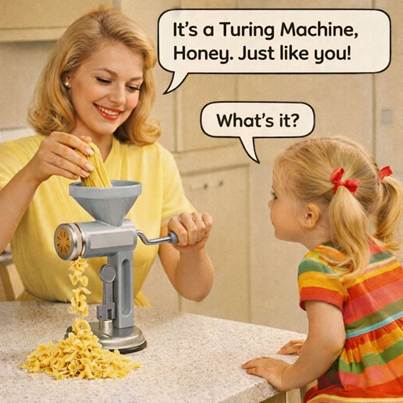
A 1960s-style kitchen image—mother cranking a pasta
machine, child watching farfalle emerge—functions as a precise
diagram of procedural emergence. The pasta machine represents a classical
Turing Machine: a constraint system that transmutes a stream of pliable
input into discrete, repeatable outputs. The farfalle are
not “food” philosophically, but tokens—stable identities produced by
rule-bound transformation. The mother and daughter are not identical to the
machine, but they share its invariant grammar. They are advanced
biological, self-regulating machines that receive unpredictable input, apply
inherited and learned constraints, and emit discrete outputs (actions, words,
decisions). The difference is degree and recursion, not kind. The mother
executes constraints; the child is acquiring them. Crucially, the “raw” input is not metaphysically
random. Every input is the output of a prior machine and functions as
unpredictable only relative to the receiving system. Dough is raw for the
pasta machine; farfalle will be raw input for chewing, digestion, and further
processes. At deeper levels, even the first emergents
are already quantised and discrete. Randomness is operational, not absolute. No meaning is implied. Constraint systems do not
interpret; they compress degrees of freedom into tokens. Any felt
meaning is a local, contingent side-effect within certain machines navigating
open, unpredictable contexts—not a property of the process itself. The mother’s line—“It’s a
Turing Machine, honey. Just like you!”—is therefore procedurally exact. The
image reveals a general law: all stable identities are outputs of
constraint-driven machines, and every output becomes someone else’s input. Making ‘farfalle’ the philosophic way, adv. |