|
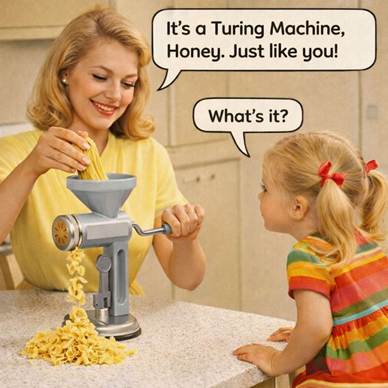
Making ‘farfalle’ the philosophic way A domestic Turing scene as a
diagram of constraint, emergence, and machine-relative randomness By the druid Finn Abstract A 1960s-style kitchen advert shows a mother cranking a
pasta machine while a child watches farfalle collect on the table. Two
speech bubbles crack the scene open: the child asks “What’s
it?” and the mother replies “It’s a Turing Machine, honey. Just like
you!” This essay takes the claim literally (not metaphorically) while
refining it against three classic critiques: (i)
the pasta machine is a classical Turing Machine, whereas mother and daughter
are advanced biological self-regulating TM systems; (ii) the input is not
“really random,” because it is itself an output of a prior Turing processes;
(iii) meaning is being smuggled in. We show that none of these critiques refute the
proposition. They specify its proper level: a universal procedural grammar
in which all emergents are machines insofar as they
are constraint-systems that transmute unpredictable inputs into discrete,
identifiable outputs, recursively feeding other machines, without requiring
inherent meaning or teleology.
1. The image as a computational diagram disguised
as an advert Start with the visual grammar before interpretation: ·
A stream of pliable stuff enters a funnel: dough/paste. ·
A transmuting device applies rule-like constraints: the machine. ·
Discrete repeatable units emerge: farfalle
tokens forming a heap. ·
A regulating agent supplies power, timing, and input control: the
mother’s hands. ·
A learning observer models the procedure by watching input → output
regularities: the child’s posture and gaze. This is already computation in the minimal sense: a
stable transformation from degrees of freedom to discrete tokens under
constraint. The advert aesthetic matters: it frames the scene as “domestic
convenience,” while the speech bubbles convert it into “ontological
disclosure.” The point is not that kitchens are computers; it is that the
same procedural pattern appears anywhere constraints compress possibility
into identity. 2. Why “machine” survives: the unavoidable term We tried to soften the word “machine”
(transducer, constraint engine, transformer). But
the attempt collapses into the same problem: whatever word we choose, the
reader eventually notices the claim being made: nothing escapes procedure; nothing emerges without
constraint; every stable identity is an output of rule-bound transformation. The offense is not the word. It is the implication. So we keep machine—Turing’s word—because it is
minimally honest: it names a thing that runs. But we sharpen it: Machine (in this essay) = any constraint system that reliably transmutes input
into discrete outputs across time, thereby stabilising token-like identities. This definition covers: ·
hand-cranked devices, ·
biochemical circuits, ·
neural loops, ·
languages, ·
institutions, ·
organisms, ·
and (in your broader
framework) quantum-to-macro iterative emergence. It does not require intention, purpose, or meaning. 3. The three-term grammar: rawness, rules, tokens The reading of the image is a clean procedural triad: 1.
Input (“raw paste”): effectively endless degrees of freedom. 2.
Constraints (“machine
rules”): fixed local transitions. 3.
Output (“farfalle”): discrete symbol-like units. This is already sufficient to justify “Turing scene.”
But later clarifications deepen it into a stronger model: rawness is not
metaphysical; it is relative to the receiving machine. 4. Resolving critique #1: the pasta machine is a TM;
the humans are not “just” TMs The critique A classical Turing Machine is discrete, sequential, and
symbol-manipulating by definition. Humans are
continuous-time, massively parallel, embodied, and self-modifying. Therefore:
“mother and daughter are Turing Machines” is false. The druid’s resolution Correct: the pasta machine is a classic TM.
Mother and daughter are advanced biological self-regulating TM systems.
The claim is not identity but lineage and grammar: ·
The pasta machine
instantiates the minimal computational grammar: constraint →
token output. ·
The humans instantiate an expanded,
self-updating version of that grammar: constraint → token output +
constraint modification. So the correct relationship is: Classical TM ⊂ machine-like constraint systems ⊂ biological self-regulating machines Or, in the druid’s register: The TM is the toy model that reveals the
invariant structure; the organism is the full-scale runtime that can
rewrite parts of its own rule-set. Example inside the image The pasta machine cannot decide to change farfalle
into fusilli mid-crank without a physical swap of parts. The mother
can alter: ·
speed, ·
pressure, ·
rhythm, ·
and even the recipe next
time. The child goes further: she is acquiring the
constraints themselves (language, motor control, social rules). In that sense
she is not merely executing; she is compiling. Thus, the mother’s line remains true if understood as: “This device is a machine in the minimal Turing sense.
You are a machine in the maximal biological TM sense. The invariant grammar
is shared.” 5. Resolving critique #2: randomness is
machine-relative; every “raw” input is prior output The critique The input is not truly random. Dough is already
structured. Human sensory input is already filtered by evolution and culture.
So “constraint creates structure from randomness” is overstated. The druid’s resolution You don’t need absolute randomness. You need unpredictability
relative to the machine’s available constraints. The druid proposes a cascade: ·
The dough is the output
of a previous machine (mixing, kneading, cultural recipe, supply chain,
agriculture, chemistry). ·
To the pasta machine,
however, it is raw: it arrives as a pliable continuum that must be
discretised by the machine’s local rules. ·
The
farfalle will in turn become quasi-random input to another
machine (chewing, digestion, metabolism, social mealtime ritual). ·
Under deeper reduction: at
the quantum “initial status,” the first confinement yields discrete events—quantised
in the druid’s terms—so “rawness” is already discretised at the base. So “random” here means: not that it lacks structure in
itself, but that it is not predictable for this machine at the
level relevant to its transmutation. This is the crucial upgrade. It converts the picture
into a general law: All emergents
are outputs of prior machines that function as unpredictable inputs to
subsequent machines. Example inside the image To the mother, the dough is not random—she knows the
recipe. The same object migrates across layers as: ·
structured output →
raw input → token output → raw input again. This is precisely how a world can be lawful yet
locally unpredictable without invoking metaphysical chaos. 6. Resolving critique #3: no meaning is implied;
meaning is at most local feeling, not a property of the process The critique Talking about symbols and outputs risks smuggling in
semantics (“meaning”), especially when humans are in the scene. The druid’s resolution He explicitly denies meaning as an ontological
ingredient: ·
There is no meaning
in the system. ·
There is only constraint
interaction under open, unpredictable contexts. ·
Any “meaning” that appears
is not in the outputs; it is a local, transient effect within certain
machines (mother/daughter) navigating survival. So we distinguish: ·
Syntax: token formation by rules (farfalle emergence). ·
Semantics: meaning as interpretation (not required; not
assumed). ·
Pragmatics: local use/feeling within a context (possible in
biological machines, but contingent). The image becomes sharper when semantics are refused: farfalle are not “messages.” They are tokens—stable
units that can be counted, manipulated, consumed, exchanged. Example inside the image The pasta machine “produces
farfalle” without understanding pasta. 7. The mother’s line, stated precisely After all refinements, the mother’s speech bubble can
be translated into a formally safer proposition: “This device is a classical constraint machine that
maps a stream into discrete tokens. You and I are higher-order
self-regulating constraint machines that do the same—continuously—using
sensory streams and cultural rule-sets to emit
actions and symbols. The difference is degree and recursion, not kind.” So yes: the mother is right. But she is right only because we have reduced
“Turing Machine” to its invariant grammar rather than its classroom
caricature. 8. The deeper implication: identity as stable
output of constraint collisions The druid’s broader Procedure Monism frame (discrete interactions; identity as operational
stability; emergence by collisions of constrained momenta) fits the picture
almost too well: ·
Dough = a field of degrees
of freedom (already conditioned by prior constraints). ·
Machine = boundary
conditions enforcing a lawful channel. ·
Farfalle = operationally
stable identities—tokens—produced by repeated constraint collisions. The scene is therefore not merely “computation.” It is identity
manufacturing. And the child kneeling across the table is the hidden
punchline: she is watching token emergence because she is a token-emergence
system learning how tokens work. 9. Examples beyond the kitchen (to show the
invariant structure) 1.
Genetics: nucleotide “paste” enters ribosomal constraints;
proteins emerge as discrete functional tokens; proteins become inputs to
cellular machines. 2.
Language acquisition: acoustic noise enters neural constraints;
phonemes/words emerge; words become inputs to social machines. 3.
Markets: heterogeneous desires enter institutional
constraints; prices emerge; prices become inputs to further constraints. 4.
Personal identity: sensory flux enters cognitive constraints; stable
self-models emerge; self-model outputs feed back as
new constraints. In each case: output tokens become someone else’s raw
input. Conclusion: why we are “stuck with machine,” and
why that is the point We are stuck with (the word) machine
because the reality described is mechanically true: ·
Emergence is transmutation
under constraint. ·
“Random” means unpredictable
for a given receiver. ·
Outputs are tokens; tokens
become inputs. ·
Meaning is not required; at most
it is a local, contingent side-effect in some machines. ·
Humans differ from classical
Turing Machines not by escaping the grammar, but by recursively rewriting
parts of it. So the advert becomes a metaphysical disclosure: The pasta machine is a Turing Machine in miniature. If the scene feels disturbing, that is not because
“machine” is a bad word. |