|
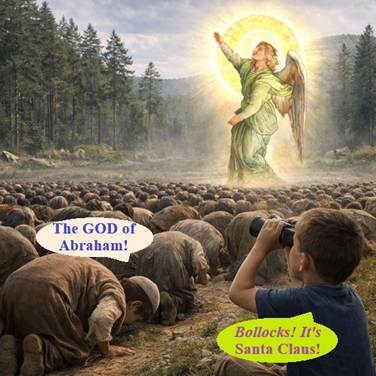
The druid
said:
“Bollocks! It’s Santa Claus!”
The image
stages a clean developmental transition within a single human system: from acceptance
of given representations to active verification of reality. Nothing in
the environment changes. The luminous figure remains the same. What differs
is the mode of processing. On the
left, the group and the kneeling boy operate in an infantile system-state.
Reality is taken as externally defined, hence dualistic. Authority and
representation are fused. The posture—heads down, bodies lowered—mirrors the
cognitive structure: no verification loop. The declaration “The GOD of
Abraham!” is not a conclusion but a received label, stabilising group
cohesion and reducing uncertainty. This mode is not an error; it is a
necessary early-life dualistic compression strategy that enables rapid
orientation and survival. On the
right, the seated boy introduces a different architecture. He is upright,
engaged, and uses a tool—binoculars—to increase resolution. This marks the juvenile
(i.e. adolescent) transition: from
passive reception to directed (and
engaged) sampling. His statement, “It’s Santa
Claus!”, reflects a structural shift already familiar in childhood
development—the recognition that representations can be constructed,
functional, and non-literal. The Santa Claus analogy captures the moment
when the system distinguishes appearance from source. The
critical point is not disbelief, but model updating. The boy is not rejecting
meaning; he is refining it through evidence. The image
therefore encodes a broader pattern: while all humans begin in a
belief-dependent mode, not all humans transition fully into (adolescent) verification (and, later,
into (adult) survival ensuring
application). Many adults retain early-stage representations because they
continue to serve psychological, social, or political survival functions.
These representations persist as stabilising (i.e. comforting, orienting) placeholders, even
when higher-resolution tools are available. In final
terms: ·
The kneeling group = analogue acceptance of an
inherited model ·
The observing boy = targeted verification and
adaptive revision The
figure does not change. Same Vision,
Different Resolution From Dualism via Non-Dualism to Monism |