|
Same Vision, Different Resolution: From worship to verification
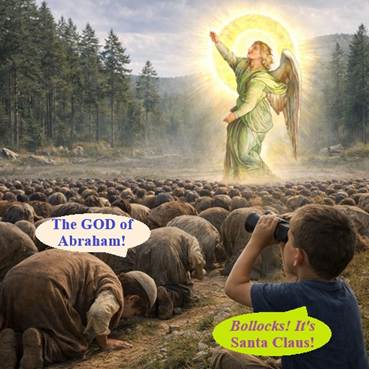
The image
is effective because it does not merely depict a disagreement about religion.
It formalises a developmental and cognitive transition. What it places
before us is not two different worlds, but two different ways of rendering
the same world. The luminous figure in the distance is one and the same
for all present. The clearing, the crowd, the glow, the posture of awe, the
forest backdrop: all are shared. Yet within that common scene two radically
different psychological architectures are operating. On the
left and across the mass of kneeling figures, the scene is interpreted
through what may be called an infantile dualistic
mentality. On the right, in the seated boy with binoculars, the
same scene is subjected to scrutiny, comparison, and revision. The power of
the image lies in this contrast. It shows the same stimulus processed under
two different developmental regimes. One regime accepts. The other
investigates. One kneels before a representation. The other tests it. That is
why the image works as a thought experiment. It asks a blunt question: At
what point does a human being stop taking survival-serving projections as
literal external truth and begin to recognise them as internally generated or
socially maintained models? That is
the real subject here. 1. The Image as Developmental Diagram The first
thing to notice is that the image is structurally simple. It is almost
schematic. There is: ·
a distant radiant figure;
·
a collective of worshippers bent in submission; ·
one child within the collective repeating the
inherited interpretation; ·
one child outside or on the edge of that
interpretive frame, using an optical instrument; ·
a clash of captions. The
worshipping child says: “The GOD of Abraham!” These
speech bubbles are not merely comic. They encode two levels of model
formation. The first
bubble is received language. It is tradition speaking through the
child. The child does not inspect the figure, parse its features, compare it
against a catalogue of possibilities, and then reason toward “The God of
Abraham.” He inherits the label in advance. His act is one of recognition
by prior script. The world appears, and the name already exists. The
second bubble is different. It is crude, irreverent, and epistemically
active. The boy with binoculars is not simply rejecting. He is resolving.
He brings the distant figure into closer view and identifies features
inconsistent with the grand interpretation of the crowd. His conclusion may
itself still be immature, partial, or humorous, but the critical shift has
already occurred: he is no longer passively inhabited by the inherited label.
He is checking the object against the claim. That is
the developmental pivot. 2. Infant Consciousness and the Need for External Guide
& Control In early
development, the human infant does not live in a neutral universe of
independently tested propositions. The infant lives in dependence. It must.
It lacks the autonomy, motor capacity, perceptual integration, and
inferential robustness required to manage the world on its own. Therefore,
the infantile system is necessarily built around external guide and
control. That is not
pathology. It is design. The
infant survives by entrusting itself to larger powers: ·
the mother, ·
the father, ·
the household, ·
the tribe, ·
the institution, ·
the story. In this
phase, the world is not encountered primarily as an object to be analysed. It
is encountered as a field of authoritative givens. Meaning comes from
outside. Protection comes from outside. Rules come from outside. Punishment
and reward come from outside. Even emotional regulation is externally
scaffolded. Hence the
infantile mind is naturally dualistic in a specific sense: there is the
dependent self here, and the controlling source there. One
receives; the other provides. One obeys; the other knows. One needs; the
other commands. Within
such a structure, the externalised figure of god is
not an intellectual mistake so much as a developmental continuation of
the original dependency architecture. The child who trusts that an unseen
benevolent agent watches, judges, rewards, protects, and explains is not
doing something alien. He is extending into symbolic space the same
relational pattern that governed his biological helplessness. Santa
Claus is the classic benign example. He sees you, knows your conduct,
remembers your desires, rewards the good, withholds from the bad, and
inhabits an invisible logistical order beyond the child’s grasp. This is a
perfect infantile guide-and-control representation: surveillance plus
benevolence, mystery plus gift. The
crucial point is that such figures are not random. They are psychologically
elegant because they sit naturally on top of the child’s pre-existing
dependence structures. So when the image juxtaposes
“The God of Abraham” with “It’s Santa Claus!”, it is not simply making a
cheap equivalence between religion and childish fantasy. It is making a more
exact claim: both operate on the same basic developmental template of
external guide-and-control representation. 3. Why Such Representations Are Functional To call a
representation infantile is not to call it useless. Quite the reverse. It is
often highly functional. Why do
children accept Santa Claus? Because the figure does real work: ·
it intensifies excitement;
·
structures behaviour; ·
anchors ritual time; ·
personalises reward; ·
stabilises trust in family theatre;
·
renders an abstract social world emotionally
graspable. The
representation is false in a literal sense but useful in a developmental
sense. It helps the child inhabit a structured universe before the child can
understand the actual mechanisms by which households, economies, and social
rituals operate. Exactly the same logic can be scaled. At the
level of group life, grand external figures of authority do comparable work: ·
they bind a population into one symbolic field; ·
legitimate moral expectations;
·
organise sacrifice and obedience;
·
reduce existential uncertainty;
·
transform contingency into purpose;
·
make suffering narratable;
·
convert power structures into sacred structures. Thus the image’s crowd is not
merely foolish. It is performing a survival function. The crowd kneels
because kneeling is an embodied form of cognitive simplification. Submission
lowers the burden of independent adjudication. Once the object is named by
the group, the individual can rest inside the inherited certainty. This
matters. A human system under stress often prefers stability over truth,
cohesion over accuracy, and orientation over resolution. The
crowd’s interpretive error, if error it is, may persist precisely because it
is socially and emotionally efficient. That is
why many adults retain beliefs generated in earlier developmental phases. Not
because they are incapable of intelligence, but because the belief continues
to pay rent: ·
it secures belonging, ·
authorises identity, ·
justifies hierarchy, ·
relieves uncertainty, ·
supplies moral drama, ·
protects against existential flatness. In plain
terms: many people keep the symbolic Santa because the system still needs
him. 4. The Juvenile Shift: From Reception to Inspection The boy
on the right marks the beginning of a new mode. He is not yet a mature philosopher.
He is a juvenile observer. That is exactly why he is so important. He stands
for the moment when the mind first discovers that the given interpretation
may not be the final one. This is a
decisive developmental event. By
roughly the age at which children begin to abandon literal Santa belief,
something structural happens. The child starts to grasp: ·
adults can stage realities;
·
symbols can be functional without being factual; ·
appearance can be curated;
·
authority can misdirect benignly;
·
stories can console without corresponding to
external entities. This is
not merely learning a fact about Christmas. It is a reorganisation of
cognition. The child begins to understand representation as representation. Before
this shift, the sign and the thing are fused. That is
what the binoculars represent. They are not just a physical instrument. They
are an epistemic symbol. They stand for all means by which a system increases
resolution: ·
focused attention, ·
closer inspection, ·
methodological doubt, ·
comparative checking, ·
enlargement of details, ·
refusal of group default. The boy
is seated in profile, detached enough from the mass posture to see. He has
not simply stood up physically. He has stood up cognitively. While the others
kneel into the story, he narrows the distance between perception and object.
He does not ask, “What does everyone say this is?” He asks, “What is it, on
closer look?” That is
the birth of verification. 5. “It’s Santa Claus!” as a Juvenile Rather Than Final
Conclusion The boy’s
conclusion is still limited. He does not say, “This is a culturally mediated symbolic
construct generated by the developmental needs of dependent systems and
sustained into adulthood by collective identity dynamics.” He says,
“Bollocks! It’s Santa Claus!” That is
appropriate. He has not reached full theoretical maturity. He has reached a
first-order demystification. He has recognised that the grand object may be
another instance of a familiar representational trick. This is
how development often proceeds. We do not move from naïve belief directly to
final philosophical clarity. We pass through intermediate recognitions. The boy’s
statement therefore has two layers: 1. literal
identification of a visual similarity or type; 2. implicit
recognition that the crowd is over-reading the phenomenon. In that sense,
“Santa Claus” functions as a category marker for benignly fabricated
external authority figures designed to enthral dependent minds. It is
less a final proposition than a juvenile taxonomic breakthrough. The crowd
says: external creator. Even if
his replacement category is rough, the deeper movement is correct. He has
begun to understand that grand figures can be generated for the sake of
comfort, guidance, excitement, obedience, and cohesion. That is
already a revolution. 6. The Persistence of Infantile Structures in Adults The
druid’s key point is that many adults continue to inhabit cognitive
structures formed in early dependency phases. This is psychologically
plausible and culturally obvious. Development
does not proceed uniformly. Biological maturity is not the same as symbolic
maturity. A forty-year-old may be fully adult in work, family, and language,
yet still operate within an inherited external-guide-and-control architecture
when approaching ultimate questions. Why? Because
developmental residues persist when they remain useful. There is no law of
nature requiring a system to abandon an earlier model if that model still
delivers advantages. If a belief system: ·
confers prestige, ·
binds one into a group, ·
grants moral certainty, ·
simplifies politics, ·
frames enemies, ·
consoles against death, ·
legitimates authority, ·
converts private fear into public righteousness, then the
system may keep it indefinitely. In such
cases the external god-image functions not as a carefully inferred hypothesis
but as a survival-stabilising projection. It can be intensely defended
because attacks on it are experienced not as corrections but as threats to
the supporting structure of the self and group. This is
where the image acquires its adult seriousness. The kneeling mass is not just
a crowd of simpletons. It is a portrait of what happens when developmental
placeholders harden into permanent identity infrastructure. A symbolic tool
that was once adaptive for the immature system becomes politically and
psychologically entrenched. The
result is a peculiar situation: adults who are highly competent in local,
practical domains may remain childlike in their handling of ultimate symbolic
representations. They can operate machines, manage finances, conduct warfare,
and administer institutions, yet still treat inherited cosmic figures in the
way a child treats Santa before the break. That is
not because the adult mind is uniformly weak. It is because domains of
cognition can mature unevenly. 7. Projection in the Service of Survival The image
also invites a strong functional interpretation. The radiant being in the
clearing can be understood as a projection—not in the trivial sense that
nothing is there, but in the deeper sense that what is taken to be there
is shaped by the needs of the perceiver. Projection
here means that the system externalises its own requirements in
representational form: ·
need for protection becomes guardian;
·
need for order becomes lawgiver;
·
need for reward becomes benefactor;
·
need for explanation becomes creator;
·
need for surveillance becomes all-seeing judge; ·
need for belonging becomes chosen people. This is
not arbitrary delusion. It is the psyche performing survival work under
uncertainty. The
infant projects because it must simplify a world too large for it. The tribe
projects because collective life requires emotionally potent symbols. The
state projects because populations are easier to organise around sanctified
narratives than around raw contingency. The political actor projects because
sacred certainty is a formidable mobilising tool. Thus belief in external
guide-and-control often persists not in spite of its
immaturity but because immaturity itself can be politically exploitable and
socially adhesive. The image
captures this elegantly. The mass of bowed bodies suggests a collective
system whose survival is intertwined with submission to the symbolic object.
The lone observer suggests the disruptive possibility that the object is not
what the system needs it to be. And that
is dangerous. For if the object is projection, then the authority derived
from it is also projection-backed. The binocular boy threatens not merely an
idea but a whole ecology of dependence. 8. Santa Claus as Developmental Key Santa
Claus is especially useful in this thought experiment because nearly everyone
recognises the structure. The child
believes because: ·
trusted adults affirm it, ·
rituals reinforce it, ·
material rewards appear to confirm it, ·
emotional investment makes doubt costly, ·
the system is designed to be immersive. Eventually
the child notices discrepancies: ·
logistics do not add up, ·
adult behaviour becomes suspicious, ·
evidence accumulates, ·
peers compare notes, ·
direct observation or reasoning defeats the myth.
At that
moment the child does not merely lose Santa. The child acquires a
generalisable insight: This
insight can then be extended: ·
to advertising, ·
to political spectacle, ·
to ceremonial nationalism, ·
to charisma, ·
to sacred pageantry, ·
to ideological rhetoric, ·
to mythic identity constructions. The deeper
lesson is not “adults lie.” It is: human systems
manufacture representations that function before they correspond. The image
leverages that insight by suggesting that certain god-concepts may be
continuations of the same representational logic. Not identical in all
respects, but structurally related. The adult who clings to a fatherly cosmic
supervisor may, on this reading, be preserving a developmental form long
after its explanatory adequacy should have expired. 9. The Two Boys as Two Stages of One Mind One
should resist reading the two boys as two different kinds of people. More
powerfully, they can be understood as two stages or possibilities within
the same developmental continuum. The
kneeling boy is the mind before demystification. This
makes the image inward as much as outward. It is not only about “them,” the
gullible masses. It is about the universal human passage from trust to
scrutiny, from absorption in inherited narratives to the independent testing
of appearances. Everyone
begins in the left-hand mode. No one starts as a binocular rationalist. The
infant cannot. Trust precedes inspection. Dependence precedes autonomy.
Symbolic immersion precedes symbolic critique. Hence the
image is not cruel unless misread. It is diagnostic. It says: ·
first we
kneel, ·
then we look, ·
then perhaps we understand what kneeling was for.
That is a
humane reading. It also saves
the analysis from cheap superiority. The observing boy is not metaphysically
superior. He is developmentally later. He sees because conditions have arisen
that permit seeing. Had he remained younger, more dependent, more frightened,
more socially enclosed, he too would kneel without question. The
transition is developmental, not moralistic. 10. The Crowd as Analogue Consciousness Under Low
Resolution There is
another way to frame the scene, especially in light of
the druid’s previous discussions about consciousness as a user-friendly
analogue rendering of underlying informational complexity. The
crowd’s worship can be understood as a low-resolution analogue rendering
of something distant, bright, ambiguous, and emotionally charged. When
resolution is low, systems fill in according to prior templates. A glowing
anthropomorphic figure is not experienced as raw data. It is immediately
rendered into the nearest emotionally and culturally available significance
model. Thus: ·
low resolution plus inherited script yields “The
God of Abraham.” The
observing boy, by increasing visual resolution, interrupts default analogue
completion. He reduces the interpretive space available for fantasy or
inherited naming. More data constrains projection. This is a
crucial epistemic principle. Under low resolution, the mind supplies. Under
high resolution, the object pushes back. Examples
are everywhere. At a
distance: ·
a rope becomes a snake; ·
a stranger becomes a threat;
·
a coincidence becomes providence;
·
a political leader becomes a saviour;
·
a natural event becomes divine sign. Closer
inspection may reverse the rendering. So the binoculars are the
anti-projection device. They do not guarantee final truth, but they increase
resistance to premature symbolic closure. 11. Social Examples Beyond Religion The
thought experiment generalises far beyond religious imagery. Consider
politics. A population under strain often invests leaders with paternal or
salvific properties. The leader becomes: ·
protector, ·
restorer, ·
chosen instrument, ·
embodiment of the nation, ·
singular answer to diffuse anxiety. Crowd
posture becomes symbolic kneeling even when literal kneeling is absent.
People surrender judgment because the figure simplifies complexity. Again,
the issue is not mere ignorance. The issue is the attractiveness of external
guide-and-control under conditions of uncertainty. Or
consider consumer culture. Brands become quasi-sacred. Products are not sold
as objects but as identity, redemption, transformation. Low-resolution desire
is guided by staged representations. Most do not inspect the machinery. A few
use the binoculars of criticism and see the fabrication. Or
consider institutions of prestige. Academic, legal, or bureaucratic language
can produce halos around weak arguments. People defer because the signal
arrives wrapped in authority. Closer inspection often reveals a Santa
mechanism: costume, ritual, inherited reverence, and strategic mystification. The
structure repeats: ·
representation first, ·
submission second, ·
verification rare. The image
therefore has wide diagnostic force. It is about how systems relate to
powerfully charged appearances, not only about theological belief. 12. The Harsh but Clean Bottom Line What then
is the hard conclusion? The image
proposes that much of what passes for ultimate truth in human affairs may
originate as developmentally useful projection, later preserved
because it remains advantageous to individuals and groups. Early-stage
consciousness requires external guide-and-control. It naturally fabricates or
absorbs personified agencies that reassure, command, reward, and explain. At
a later stage, some individuals begin to inspect the representation rather
than submit to it. They discover that the object may be less transcendent
than advertised. This does
not mean all symbolic representation is worthless. It means symbolic
representation must be understood as function before ontology. One
must ask not first, “Is it holy?” but, “What work is
it doing? For whom? Under what developmental conditions? At what resolution?” That is
the method implied by the boy with binoculars. The crowd
says: believe what stabilises. The image
is therefore about human maturation as the transition from inherited
projection to active verification. Not all
make that transition. Some make it in one domain but not another. Many adults
preserve infantile representations because those representations continue to
support psychological comfort, social belonging, and political order. So the final contrast is not
between religion and atheism, nor between good people and bad people, nor
between tradition and modernity. It is
between: ·
systems that continue to live by externally given
interpretive scripts, and ·
systems that begin to test the script against the
object. That is
why the title fits: Same
Vision, Different Resolution. The
figure in the clearing does not change. And that,
finally, is the ruthless elegance of the thought experiment: From Dualism via Non-Dualism to Monism Top of Form
|