|
The Anathema of
Immanence Why Monism Is Tabu The
declaration "Monism is tabu" is not merely an empirical
observation of historical religious censorship; it is an apodictic imperative
built into the architecture of institutional civilization. Wherever human
societies construct hierarchies—whether ecclesiastical, imperial, juristic,
or moral—they depend entirely on maintaining categorical, dualistic
distinctions: Creator and Created, Sacred and Profane, Ruler and Ruled,
Subject and Object. Monism—the
metaphysical assertion that all reality is reducible to a single, indivisible
substance, principle, or operational procedure—acts as an existential
solvent upon these distinctions. By collapsing the transcendent boundary
between the divine and the material, or between the observer and the
observed, monism renders institutional mediation obsolete. Consequently,
dogmatic orthodoxy across Mediterranean monotheisms, state ideologies, and formal
legal frameworks has historically treated unitive metaphysics not as a mere
intellectual error, but as the ultimate treason: a social and cosmological taboo
(tabu). 1. The Anomy of Unity: Categorical Entropy and the
Mosaic Distinction To
understand why monism triggers absolute prohibition, one must examine the
mechanics of social and religious order. As anthropologist Mary Douglas
established in Purity and Danger, order is produced through
classification; "pollution" or "taboo" is that which threatens,
crosses, or blurs fundamental boundaries. In The
Mosaic Distinction, philosopher Jan Assmann demonstrates that the birth
of radical transcendent monotheism introduced a structural dualism into
Western consciousness: the absolute division between the true God and false
gods, Creator and Creation, Nature and the Divine. In this dualist framework,
order is guaranteed by an external, transcendent Lawgiver who operates upon
the world from beyond it. DUALIST
ARCHITECTURE (Institutional Necessity) Transcendent
God / Sovereign State │ (External Law &
Judgement) ▼ [ Absolute Ontological Barrier
] │ (Institutional
Intermediaries: Clergy, Sacraments, Code) ▼ Finite
Creation / Subject / Nature ----------------------------------------------------- MONISTIC
ARCHITECTURE (Subversive Dissolution) ┌────────────────────────────────────────────────────────────────┐ │ SINGLE SUBSTANCE /
PROCESS │ │ │ │ Creator ≡ Creation |
Lawgiver ≡ Law | Self ≡ Whole │ └────────────────────────────────────────────────────────────────┘ When
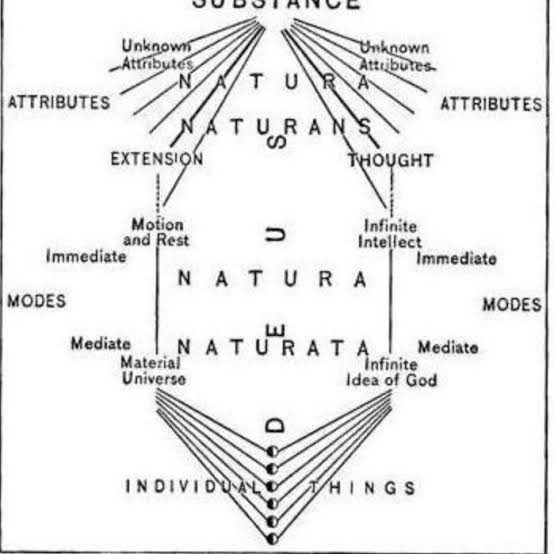
monism asserts that God and Nature are identical (Deus sive
Natura), or that the human ‘soul’ is intrinsically of the same essence as
the Divine, it introduces categorical entropy. 1. The
Collapse of Moral Judgment: If all that exists is an
iteration of a single underlying substance or procedure, the absolute opposition
between Good and Evil loses its ontological grounding. Evil can no longer be
an autonomous rebellion against God, but merely a localized constraint or
modal variation within the Whole. 2. The
Obsolescence of Intermediaries: Dualist institutions derive
their power by acting as brokers across the ontological divide. A church, a
priesthood, or a legal tribunal exists to bridge the gulf between the
transcendent ideal and the fallen, profane reality. If the profane is already
inherent in the divine, the broker loses all leverage. 2. The Mechanics of Dissimulation: How the "Closet
Monists" Survived Because
explicit monism invited excommunication, burning at the stake, or execution,
unitive thinkers operated in plain sight through deliberate structural,
linguistic, and symbolic dissimulation. They constructed intellectual
camouflage, masking their unitive metaphysics in idioms acceptable to the
ruling orthodoxies of their era. SUBSTANCE
Spinoza's
geometric mapping of Deus sive Natura. Source: FRDH
Podcast A. Apophatic Theology: Monism under the Mask of
Transcendent Humility Within
Christianity and Islam, the safest vehicle for monism was via negativa (negative theology)—the doctrine that God
cannot be described by positive attributes. Monists pushed divine
transcendence to such an absolute extreme that it paradoxically inverted into
unitive immanence. John
Scotus Erigena (~815–877 CE) operated within the Carolingian court by framing
his monistic cosmos in Neoplatonic Christian vocabulary. In Periphyseon, he systematically dissolved the
boundary between God and Creation: "God
is not only made in all things, but He Himself makes all things... For He is
the true being of all things, because He alone truly is." — John
Scotus Erigena, Periphyseon, Book III Erigena
avoided immediate execution by framing his system as an amplification of
divine majesty, yet his assertion that "God creates Himself in
Creation" was recognized centuries later as pantheistic, leading Pope
Honorius III to condemn the text in 1225. Similarly,
Meister Eckhart (~1260–1328 CE) utilized bold German vernacular and Latin
paradoxes to articulate the identity of the human soul and the Divine: "The
eye with which God sees me is the same eye with which I see Him; my eye and
His eye are one and one, one seeing and one knowing." — Meister
Eckhart, Sermon 12 When put
on trial for heresy by the Inquisition, Eckhart argued that his propositions were
merely hyperbolic praises of divine grace, though his fundamental claim
collapsed the Creator-creature separation entirely. B. Esoteric Subversion: Exoteric Shells and Esoteric
Unity In
Islamic mysticism, Sufi thinkers developed a sophisticated dual-layered
rhetoric. They maintained meticulous adherence to the exoteric Law (Sharia)
to appease clerical guardians, while simultaneously teaching the unitive
reality (Haqiqa) to initiates.
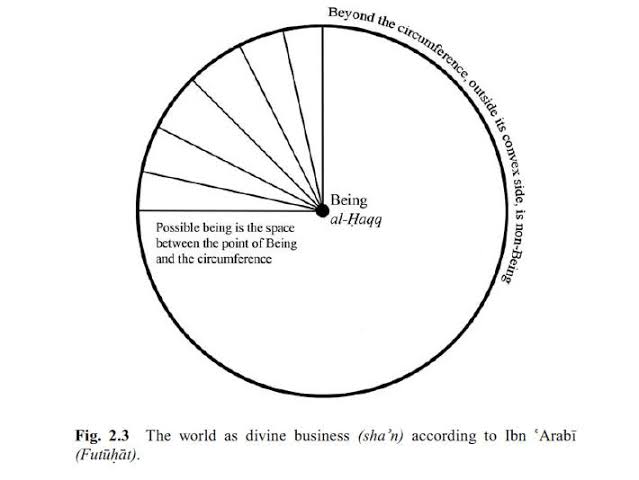
Ibn 'Arabi's cosmological diagram
of the Unity of Being. Source: Sufi Path of Love Ibn Arabi
(1165–1240 CE) formulated Wahdat al-Wujud
("The Unity of Being"). Rather than claiming "I am God"
(which led to the public execution of Mansur al-Hallaj in 922 CE), Ibn Arabi
argued that creation possesses no independent existence whatsoever; it is
merely the dynamic locus of manifestation for the One True Being: "He
who sees things without seeing the Truth in them sees nothing at all, while he
who sees the Truth and sees the things in Him sees all." — Ibn Arabi,
Fusus al-Hikam
("The Bezels of Wisdom") In the
East Asian context, Chan (Zen) Buddhism during the Tang and Song dynasties
faced intermittent imperial suppressions whenever its radical unitive
metaphysics threatened state Confucian regulation or monastic property.
Masters used direct, disruptive paradoxes (gong'an
/ koan) to bypass conceptual dualism entirely: "The
Master said to them: All the Buddhas and all sentient beings are nothing but
the One Mind, beside which nothing exists. This Mind has beginninglessly
been unborn and imperishable." — Huangbo
Xiyun (d. 850 CE), Transmission of Mind HISTORICAL
MONIST CAMOUFLAGE STRATEGIES ┌──────────────────────────┬───────────────────────────────┬────────────────────────────────────────┐ │
Historical Era │
Prevailing Orthodoxy │
Disguise / Camouflage Strategy │ ├──────────────────────────┼───────────────────────────────┼────────────────────────────────────────┤ │
Classical Antiquity │
Polytheistic State Religion │
Natural Philosophy & Cosmological Fire │ │
Medieval Christianity │
Transcendent Monotheism │
Apophatic / Negative Theology │ │
Medieval Islam │
Clerical Jurisprudence │
Esoteric Hermeneutics & Poetic Allegory│ │
Early Modern Europe │
Ecclesiastical Dogma │
Geometric Logic & Substance Physics
│ │
Modern / Post-Religious
│ Dualist Materialism & Biologism│
Computational & Process Cybernetics
│ └──────────────────────────┴───────────────────────────────┴────────────────────────────────────────┘ 3. The Apodictic Imperative The
statement "Monism is tabu" is an absolute necessity for any
system whose power relies on division. Monism
cannot be negotiated with, integrated into, or domesticated by dualist
institutions. To accept that the observer and the observed, the ruler and the
ruled, or the divine and the mundane are iterations of a single,
self-generating procedure is to render the machinery of dogmatic control
irrelevant. Whether
disguised as the "ever-living Fire" of Heraclitus, the "One
Mind" of Huangbo, the Deus sive Natura of Spinoza, or the self-selecting
operational iterations of modern process metaphysics, monism remains the
ultimate intellectual subterranean stream—forever forbidden by the guardians of
boundary and scale yet endlessly rediscovered by those who look past the
illusion of separation. The anathema of
immanence and the failure of historical evasion |