|
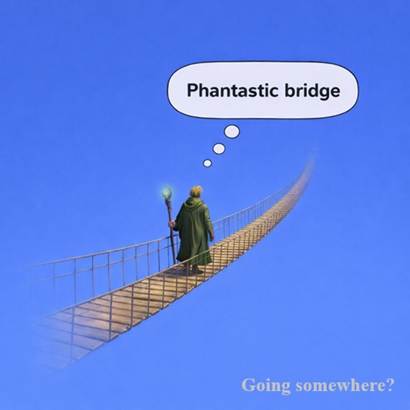
The druid
said: “Phantastic Bridge”
According
to the druid Finn, life is
not a noble quest, a sacred pilgrimage, or a carefully designed storyline. It
is a (rope) bridge (as message) floating in space with no visible
start, no visible end, and absolutely no customer service desk. The
universe, it turns out, does not come with directions. It just randomly
generates bridges and drops small mammals on them. To remain
sane, the druid cannot spend his days staring into the infinite blue void
asking, “But what is it all for?” That way lies dizziness, existential
vertigo, dread and very poor foot placement. Instead,
he performs the only workable strategy: he stares at the bridge. Hard. So hard that
the bridge becomes his world. By
focusing at 100% on the planks, the ropes, the next step, and the general
business of not falling off, the druid successfully hypnotizes himself into
thinking this particular floating walkway is
Reality™, Identity™, and Meaning™. This is
not stupidity. It is excellent engineering. Identity,
in this model, is just what happens when a creature squints so hard at one
small slice of randomness that it starts calling it “my life.” Meaning
is what you get when you treat your local rope bridge like it was designed on
purpose. The word
“phantastic” is therefore not praise. It is professional respect. The
bridge is a fantasy — but it is a very well-built fantasy. It is sturdy
enough to walk on, believable enough to live inside, and convincing enough to
forget that it’s hanging in the middle of nowhere. In short:
the druid knows it’s a floating illusion. He just
has the good sense to walk it anyway. Because
falling while philosophizing is still falling.
The bridge that builds its builder GOD as Attentional Fixation that engineers identifiable
reality Life as Attentional Compression in a Random,
Directionless World |