|
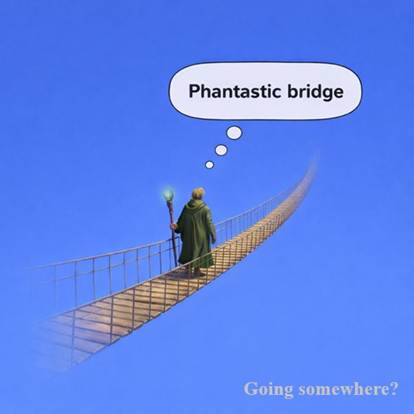
The druid said: “Phantastic Bridge” Life as Attentional
Compression in a Random, Directionless World By Victor Langheld Abstract The
druid’s minim “Phantastic bridge” is not an aesthetic remark, a poetic
metaphor, nor an expression of wonder. It is the logical compression of a
procedural diagnosis of existence itself. In this model, a life is a randomly
instantiated constraint-path within a fundamentally unpredictable,
directionless generative field. Survival, sanity, identity, and meaning do
not arise from discovering intrinsic structure in the world, but from a
forced narrowing of consciousness onto a single, local continuity structure —
the “bridge.” The bridge is not ontologically final; it is functionally
necessary. To live is to enchant oneself into a locally stabilized illusion
of realness by collapsing attention onto one provisional path and treating it
as total.
I. The Image as Formal Model The image
is not illustrative. It is schematic. A single
rope bridge floats in an otherwise empty blue space. There are no cliffs, no
banks, no visible supports, no origin, and no destination. Both ends fade
into nothing. A small druid walks forward, aligned with the bridge, hood
down, carrying a staff. A thought bubble reads: “Phantastic bridge.” This
composition removes all metaphysical comfort structures: ·
No foundational ground ·
No guaranteed origin ·
No promised destination ·
No visible anchoring (i.e. referencing) context What
remains is a single procedural fact: There is
a path, and there is walking. This is
not a romanticization of uncertainty. It is a formalization of the real
structural condition of finite existence in a generative, stochastic, random,
hence unpredictable universe. II. The Bridge as a Life, Not
as a Metaphor In this
refined model, the bridge does not represent “a method,” “a worldview,” or “a
phase.” The
bridge is a life (in
fact a dynamic transistor). A life is
a locally stable constraint-pattern that persists long enough to generate the
appearance of continuity. It is not a journey toward something. It is not a
meaningful arc embedded in cosmic purpose. It is a temporary procedural, i.e. constraints/rules corridor carved out of randomness. From the
druid Finn’s Procedure
Monism standpoint: ·
Existence is iterative, not teleological ·
Identity is operational, contingent, not
essential ·
Continuity is fabricated, not given The
bridge is therefore not symbolic. It is literal in procedural terms: A life, i.e. any emergent as identifiable reality, happens as a narrow, walkable (i.e. computable) strip of (constraints or rules) coherence inside a
fundamentally incoherent total field. III. Randomness and the Absence of Direction The
background is not merely unknown. It is structurally unpredictable because it
is generatively random within constraints/rules. This is
not ignorance. There is
no built-in vector to reality. No inherent “toward.” No initial or final
reference frame. Therefore: ·
No life is naturally oriented ·
No life is guaranteed narrative ·
No life has intrinsic justification Any sense
of purpose, progress, destiny, or finality is a secondary construction. The
bridge does not “lead somewhere.” IV. The Survival Compression: Consciousness Must
Collapse The druid
introduces the decisive core mechanism: He does
not survive by understanding the randomness. To remain
sane, functional, and coherent, consciousness must narrow to near-total focus
on the bridge itself. (Yoga
sutra No 2) This is
not spiritual concentration. The
effective rule is: Only what
is on the bridge is allowed to count as real (Yoga sutras Nos 3&4). Everything
else — the void, the randomness, the lack of direction — must be suppressed
(nirodha) from operational awareness. This is
not cowardice. A finite
system cannot metabolize total indeterminacy. It must fabricate a local
totality. (Yoga sutras Nos 3&4) V. Enchantment as Functional Architecture The
bridge must not merely be walked. The druid
must enchant himself. This
enchantment consists of: ·
Treating the bridge as central ·
Treating the bridge as sufficient ·
Treating the bridge as meaningful ·
Treating the bridge as his This is
not metaphysical error. Identity
itself is a self-maintaining enchantment loop: I am on
this bridge. Without
this loop, identity collapses. VI. Identity as Attentional Narrowing Within this
model, identity is not essence, soul, or metaphysical substance. Identity
is: A
sustained narrowing of awareness (Yoga
sutra No 1) onto a single constraint-path. To become
real is to exclude. Reality
is achieved by subtraction. The wider
the awareness, the less stable the identity. This
explains the procedural logic of: ·
Careers ·
Roles ·
Belief systems ·
National identities ·
Personal narratives ·
Spiritual paths Each is a
bridge-variant: a stabilized attentional corridor. VII. The Bridge as Functional Hallucination In its
bluntest formulation: A life is a stabilized
hallucination with survival value. Not
hallucination as delusion. The
bridge is not false. Meaning
is not found. VIII. The Staff: Cognitive Support, Not Power The
druid’s staff is not magical authority. It is a (blind man’s) walking
aid. It models
cognition, belief, memory, language, and narrative: All are
props that help stabilize traversal across instability. They do
not ground reality. IX. Why “Phantastic” Is Exact The word
“phantastic” is not praise. It is
precision. It means: This is
an extraordinarily effective fantasy (Yoga
Sutra No 3) Not
fantasy as error. The
bridge is fantastic because: It
convinces a finite system that it inhabits a coherent world inside a
non-coherent total process. That is
an extraordinary procedural achievement. X. The Minim as Logical Compression Fully
expanded, the druid’s minim “Phantastic bridge.” encodes: A life (i.e. any emergent is Universal Procedure iteration) is a randomly generated, directionless constraint-path
in a stochastic (quantised) universe.
To survive and remain sane, a local
system must collapse consciousness onto that path, enchant itself with its
reality, and treat that fabricated continuity as total — thereby generating
identity, meaning, and functional coherence. Or, in
druidic ‘in your face’ register: Not true. But good
enough to live inside. XI. Relation to Procedure Monism This
model aligns precisely with the druid Finn’s core commitments: ·
Discontinuity is fundamental ·
Continuity is procedural fabrication ·
Identity is operational stability ·
Meaning is feedback, not essence ·
Existence is successful iteration, not
metaphysical guarantee The
bridge is a local success-state (hence
generating nirvana 1 = moksha 1 = liberation 1) The druid
is a local token of the Universal Procedure walking (meaning computing) itself. XII. Final Compression The druid
does not say: “What a
beautiful bridge.” He says: “Phantastic bridge.” Which
means: This
illusion is so well-built that I, as
identifiable reality can live
inside it as identifiable reality. Not as
celebration. |