|
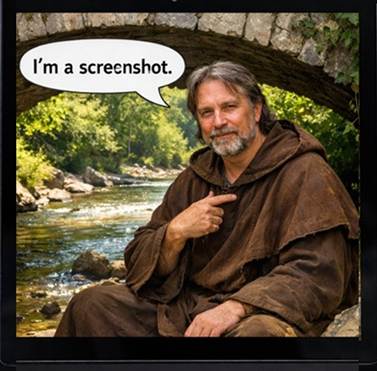
The druid said: “I’m a screenshot”
The natural systems
context of which the druid’s minim, “I’m a
screenshot,” is the logical
conclusion is this: A living being is not a substance,
not a permanent self, not a metaphysical soul-object, and not an
independently existing essence. It is a momentary, local capture of a running quantum process. What appears as “me” is a stable-looking image (a user-friendly analogue
compressed and abstracted) from a
deeper field of ongoing quantum interactions. In other words: the druid says
“I’m a screenshot” because, in a procedural universe, every identifiable
being is a frozen readout of active
computation. That is the system
context. In the druid Finn’s Procedure
Monism (as in ancient Buddhism) reality is not made of enduring things. It is
made of quantised events,
contacts, constraints, and reiterations. A self is not a block. It is a rendered result. It
is what appears when a local configuration of energy, under constraint,
achieves enough continuity to be registered, indeed identified as “this.” But
that “this” is never the whole process. It is only the visible frame (or
placeholder). A screenshot is not the
computer. It is not the code. It is not the current running depth of the
machine. It is not the electrical activity in the circuits. It is not the
total archive of prior states, nor the full range of possible next states. It
is a single captured
appearance (i.e. a systems status
report) extracted from a much larger active system.
That is exactly what the druid means by a human being. You are not the whole of
nature. You are not even the whole of your own process. You are the momentary visible arrest of a
massively distributed, mostly hidden procedure. That is why the minim
works. A screenshot has several
decisive features, all of which map cleanly onto an emergent identity. First, a screenshot is real, but only as a
reduction. It is not false. It is simply incomplete. Likewise the self. The
person is not an illusion in the cheap sense. The person is a real local
output. But it is an output stripped of the total system depth that generated
it. The error of metaphysics begins when the screenshot is mistaken for the
machine. Second, a screenshot is static appearance (i.e. a frame) carved out of dynamic
process (like a movie). Life feels continuous, but what is actually given at any moment is
more like a sequence of rendered states. You do not possess yourself as a
seamless absolute. You inherit yourself frame by frame. Each moment of “I am”
is a fresh capture. Memory then stitches these captures into the narrative
fiction of enduring identity. Third, a screenshot is observer-facing. It
exists for display. It is what can be shown and easily processed. In the same
way, the self is nature’s local display layer. It is the interface outcome of
deeper operations. Your body, your moods, your convictions, your social role,
even your name: all are display-level summaries that allow orientation,
response, and survival. They are not ultimate entities. They are pragmatic
renderings. Fourth, a screenshot is boundary-dependent. It
only exists because a frame has been drawn around a section of the ongoing
process. This is crucial. A screenshot is not the world; it is the world
under a cut. Likewise identity. “I” exists because a boundary operation
isolates one active bundle from the wider field. The druid’s older minims
already point this way: identity is address, touch is boundary, temple is
reference frame. “I’m a screenshot” simply extends the same logic into
epistemology. I am what appears when nature crops itself locally. So what is the natural
context behind the phrase? It begins with the
procedural view of reality. Nature is an unending field of constrained energy
differentials, i.e. quanta. Under proper conditions, these differentials form
temporary stabilities. These stabilities are what we call things: stones,
trees, rabbits, governments, stars, memories, persons. But none of them are
self-grounding substances. They are temporary coherences. They hold shape for
a while because the underlying procedure keeps re-running them. A person, then, is not an
ontological exception. A person is one more local coherence, except with the
special feature that this coherence can register itself. It can say “I.” It
can report experience. It can mistake its current display for its full nature. That mistake is almost
unavoidable. When you look at a
screenshot, you are seduced by the clean finality of the image. It seems
complete. It looks like the thing itself. But it is only a selection. It
excludes the background operations that made it possible. The ego functions
the same way. The present self presents as final, but it is an edited frame:
genetics omitted, microbiome omitted, planetary conditions omitted,
historical pressures omitted, unconscious processing omitted, hidden
dependency chains omitted. The “self” is the tidy image after almost
everything that matters has been cropped away. The druid’s brutality
lies exactly here: what you call yourself is
a summary image produced for local use. Take a familiar example.
You meet an old friend after ten years. You say, “You’re the same as ever.”
Clearly he is not. Different cells, different habits, different losses,
different beliefs, different endocrine profile, different social network,
different procedural state. Yet enough pattern remains that a screenshot
comparison works. You do not identify the whole process. You identify the
recurring display signature. Or think of a digital
video call freezing for half a second. For that instant, the person becomes a
still frame. But the still frame is enough for recognition. That is how
identity works in general. Recognition does not require substance; it
requires repeatable pattern
capture. This also explains why
self-knowledge is so poor. A screenshot cannot reveal the full generative
depth of the process from which it was extracted. The visible self cannot
fully see the hidden procedure that renders it. The most it can do is infer
backwards. Hence philosophy, introspection, theology, psychology, and
metaphysics: all are attempts by the screenshot to guess the operating
system. Some guesses are better
than others. The worst guesses turn
the screenshot into a soul-substance. They say: because the image persists
recognisably, there must be an eternal object underneath it. The
druid rejects this. Persistence of
recognisable output does not prove substance. It proves rerun stability. The
screen image remains because the underlying procedure keeps regenerating it
within tolerances. This has major
implications. It means personal
identity is not conserved in the strong metaphysical sense. It is refreshed.
What survives from yesterday to today is not a self-thing but a sufficiently stable rendering profile. That is enough for law, biography, affection, accountability, and
memory. It is not enough for absolute metaphysical permanence. It also means death is
not the destruction of a substance but the end of a local capture. The
screenshot disappears when the generating conditions fail (this was also the
Shakyamuni’s view). Nothing mystical is
required. The frame is no longer rendered. The image is gone. The wider
process remains. At the same time, the
minim is not nihilistic. A screenshot matters. Screenshots, user friendly
notations, are how complex systems become legible. Without them, there is no
orientation, no communication, no response. In a trackless universe, the
screenshot is how the procedure presents a usable local world to itself. In
that sense, “I’m a screenshot” is not self-denigration. It is precision. I am
a real local display of reality, not its owner and not its centre. This also connects to the
druid’s recurring attack on mystical inflation. Spiritual systems often
promise access to some deeper, truer, ultimate self beneath the ordinary one.
The druid’s answer is colder: the ordinary self is already the relevant
event, but it is only a capture. There is no need to imagine a golden
homunculus behind the image. There is only the procedure, the rendering, and
the mistaken habit of reifying the render. An analogy from biology
sharpens the point. A photograph of a flame is not the flame’s combustion.
Yet the photograph is not unrelated to the flame. It is a valid capture of
one visible state. Likewise, a person is a valid capture of an active natural
process. What is false is only the claim that the capture is the full being. Or think of a map on your
phone. It tells you where you are. It is useful, concise, actionable. But it
is not the terrain, the weather, the history of the road, the metallurgy of
the bridge, or the intentions of the other drivers. It is a survival rendering.
So are you. The self is nature’s way of saying: here is the local actionable image. Use this. That is why the minim has
bite. “I’m a screenshot” means: I am real, but reduced. And once that is seen, a
great deal of metaphysical fog clears. The soul becomes
interface continuity. So the natural systems
context is this: in a discontinuous, constrained, procedural universe, all
identifiable beings are local renderings of deeper operations. The emergent
self is not the hidden essence of reality but its current legible frame.
Therefore the druid, stripping away poetry, theology, and self-flattery, says
the only honest thing a reflective organism can say: I’m a screenshot. The druid said: “I’m
a screenshot” (compr.) The World as
Cosmetic Rendering |