|
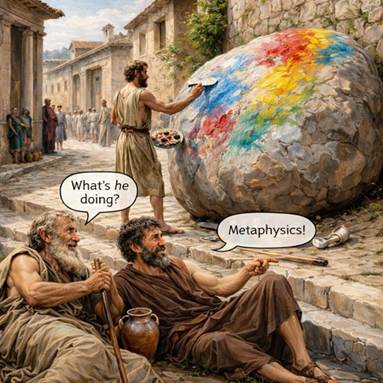
Metaphysics as Vacuous Placeholder A Functional Analysis of Its
Social Utility and Epistemic Emptiness By Bodhangkur
1. The Claim Restated: Metaphysics After Phýsis The druid
Finn’s position can be stated with precision: Metaphysics
is vacuous with respect to knowledge of reality, because nothing is known
beyond nature (phýsis). This
restores the original Aristotelian sense of ta meta ta physika
to its proper order: what comes “after” physics is not a deeper stratum of
reality, but a discursive after-effect of the limits of observation.
Metaphysics begins precisely where knowledge ends. It fills the epistemic
void with tokens that allow human systems to function despite radical
uncertainty. 2. Why Metaphysics Is Vacuous 2.1 No Generative Explanatory Gain Metaphysics
does not add generative constraints to our understanding of how phenomena
arise, persist, and dissolve. Whether one posits: ·
Brahman, ·
Dao, ·
Substance, ·
Reality ·
God, ·
Emptiness, ·
Being, no new causal
machinery is specified. No predictive capacity is gained. No operational
handle on emergence is introduced. These terms do not explain how
anything happens; they merely rename the fact that things happen. In Finn’s
terms, metaphysical concepts are naming-events
without generative content. They label the unknown; they do not model it. Example: 2.2 Metaphysics as Linguistic Zero Metaphysical
concepts function as semantic zeros: ·
They absorb contradictions. ·
They license multiple interpretations. ·
They cannot be falsified. ·
They remain immune to operational critique. This is
precisely what makes them vacuous epistemically: they have no failure
conditions. Any observation can be retrofitted to them. Example: 2.3 Nothing Is Known Beyond Nature (Phýsis) Finn’s
foundational constraint (“No God but Nature”) is decisive: There is
no access to anything beyond nature. Hence
metaphysics is not “knowledge of what is beyond physics”; it is a
narrative layer within physics produced by organisms attempting to orient
themselves under ignorance, finitude, and threat. Metaphysics is a natural
phenomenon—a behaviour of primates under uncertainty—not a window into
extra-natural structure. 3. Why Metaphysics Persists If
metaphysics is epistemically empty, why does it persist across cultures and
epochs? Because it is socially useful. Its function is not to explain
reality but to stabilise orientation. 3.1 Metaphysics as Coordination Token Metaphysical
placeholders provide: ·
Shared reference points, ·
Collective narratives, ·
Authority anchors, ·
Normative orientation. They
allow large groups to coordinate behaviour without requiring technical
literacy in physics, biology, or systems theory. Example: 3.2 Metaphysics as Anxiety Regulator Metaphysics
regulates: ·
fear of death, ·
fear of randomness, ·
fear of meaninglessness, ·
fear of loss of control. By
positing an ultimate order, ground, or truth, metaphysics buffers
organisms against the affective cost of living in an indifferent universe. In the
druid Finn’s Universal
Procedure terms:
metaphysics dampens existential noise. It is an affect-regulation technology. 3.3 Metaphysics as Institutional Infrastructure Metaphysical
systems: ·
generate priestly classes, hordes of academics, ·
legitimise interpretive authority, ·
stabilise long-lived institutions, ·
enable hierarchical transmission of norms. This
explains their cultural resilience: metaphysics is organisationally
adaptive. It produces interpreters, guardians, and custodians of the
placeholder layer. Example: 4. Metaphysics as Placeholder Within
Finn’s framework, metaphysics has the same formal structure as other vacuous
placeholders:
Metaphysics
is therefore not an error in the simple sense; it is a functional
prosthesis. The error lies in mistaking the prosthesis for a description
of reality. 5. Pathologies of Metaphysics (Failure Taxonomy) 5.1 Reification Pathology The
placeholder is treated as a real entity (God, Brahman, Substance, Emptiness). 5.2 Authority Capture Interpretive
control over metaphysical placeholders creates priestly/academic elites. 5.3 Explanatory Paralysis Appeal to
metaphysics blocks further inquiry (“it is God’s will,” “it is emptiness”). 5.4 Diversion from Observation Attention
is displaced from direct engagement with natural constraints to symbolic
manipulation of ultimate terms. 5.5 Institutional Lock-In Metaphysical
systems resist pruning because they stabilise power and identity. 6. The druid Finn’s naturalistic replacement The
druid’s alternative is not another metaphysics, but a procedural demotion
of metaphysics: ·
Treat metaphysical constructs explicitly as placeholders. ·
Use them instrumentally if they regulate
behaviour or affect. ·
Do not confuse them with discoveries about
reality. ·
Prune them when they block observation,
adaptation, or functional clarity. This
yields a hard naturalism: Nature is all there is. 7. Finn’s Final
Compression ·
Metaphysics begins where knowledge ends. ·
It explains nothing about how reality is
generated. ·
It persists because it stabilises meaning,
reduces anxiety, and enables social coordination. ·
Its danger lies in reification and authority
capture. ·
Its proper status is that of a consciously
managed placeholder, not a window onto ultimate reality. Final
formulation: Metaphysics
is not false. Two Truths or Two
Distractions? |