|
The Four States of Emergence Moksha/liberation as a mode-switch in the
Universal Procedure By Bodhangkur
Mahathero
1. The invariant four-state grammar of all emergents Any
emergent that can (a) persist long enough to be identifiable and (b) interact
enough to count as “doing something” will exhibit a minimal, repeatable
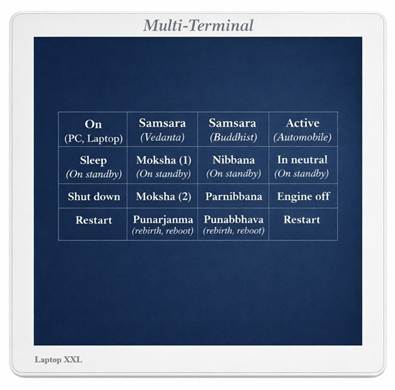
state-space. The druid’s diagram isolates a four-state grammar that
appears in machines (PC/automobile) and in spiritual soteriologies
(Vedanta/Buddhism) because it is not “religious” or “mechanical” in the first
instance. It is procedural. That
grammar is: 1. ON /
ACTIVE 2. SLEEP /
STANDBY 3. SHUT DOWN 4. RESTART This is
not a list of “possible experiences” but a list of possible operational
modes for anything that can run, pause, cease, and re-instantiate. The
claim is strong: if a system has identity-as-function (i.e., it is
recognisable by what it does), then these four are not optional add-ons. They
are the minimal state transitions required for an entity to exist as an
entity across time. To say it
sharply: an emergent is a procedure with a power state. And once
power-state enters, these four modes become invariant. 2. ON / ACTIVE: samsara as
transactional identity 2.1 What “ON” means procedurally In a
computer, ON is not merely “electricity present.” It is process execution:
loops, memory reads/writes, interrupts, IO, error correction, heat, timing. The
system is “alive” in the strict sense that it is doing work. In the
druid’s mapping, this is samsara: not “worldly life” as
moral failure, but transactional reality—the state in which an
emergent actively engages, differentiates, selects, prefers, avoids, gains,
loses, and thereby accrues consequences. Procedurally: ·
Identity is enacted. ·
The world is parsed. ·
Action produces residue. This is
the deep reason samsara
is experienced as “binding”: not because the world is
evil, but because running a process necessarily produces state. State
is memory; memory is constraint; constraint is limitation; limitation is
identity. 2.2 Karma as write-operations The
druid’s thought experiment gains force when karma is read minimally and
non-morally as write-operations—the accumulation of state resulting
from action. ·
A PC running programs is continually writing to
RAM, to disk caches, to logs, to registers. ·
A human mind engaged in preference and aversion
is continually writing to habit loops, affective priors, social commitments,
expectations, fears. “Karmic residue” is then
simply: the persistence of prior writes into current operation. A clean
non-judgemental formulation: In ON
mode, action is not free. Action is a function of state. Thus samsara is not “sin.”
It is the thermodynamics of identity: once you run, you accumulate. 2.3 Examples: ON as
entangling adequacy ·
Automobile: engine on, car in gear:
movement requires continuous micro-corrections; friction produces heat; wear
accumulates; fuel is consumed. ·
Biology: metabolism is ON mode; survival
is a continuous transaction with scarcity. ·
Culture: institutions are ON mode; they persist by reproducing constraints,
not by dissolving them. ON is always productive—and therefore always
entangling. 3. SLEEP / ON STANDBY: moksha-1 / nibbāna
as suspended transaction 3.1 Standby is not off: it is quiescent
power Standby is a remarkable
invention: the system remains powered, but the costly, residue-generating
loops are reduced or suspended. Minimal identity is preserved (a kernel, a
context), while active engagement is paused. This maps
with striking precision onto the “moksha (1)” / “nibbāna” row: release
while embodied, i.e., the system is still “on” (alive) but not
“running the world.” This is
why descriptions of liberation-in-life often converge on: ·
awareness without object ·
consciousness without content ·
being without “I-am-doing” ·
non-grasping, non-reactivity ·
cessation of craving/aversion loops The
mapping becomes technically clean if one makes a single move: “Content” is not a substance. On Standby is not
the acquisition of a new cosmic truth. It is the suspension of transactional
parsing. 3.2 Nirodha as throttle and gate The Yogic
term nirodha becomes legible as a
control operation: ·
It is not “suppression” as moral violence. ·
It is the system’s attempt to stop automatic
writes. Nirodha is the
strategic inhibition of: ·
preferential loops (craving/aversion) ·
narrative loops (identity maintenance) ·
reactive loops (threat circuitry) ·
compulsive meaning-production (conceptual
overflow) In
computer terms: the system stops running user-space programs, keeps minimal
OS presence. In spiritual terms: “I am” without “I am doing.” 3.3 Why on-standby feels ubiquitous A further
insight states: “consciousness without content, hence ubiquitous” and “being
without identity, hence ubiquitous.” This is an important technical claim. Identity
requires boundaries. Boundaries require distinctions. Distinctions require
transactions (this vs that). When transaction ceases: ·
the boundary is no longer being enacted, ·
localisation loses its operational meaning, ·
the “here” that depends on “not-there” dissolves. So the
experience becomes “everywhere” not by magical expansion, but because the system has
stopped generating the partition that makes “somewhere” possible. Ubiquity
is therefore a void (i.e. negative) phenomenon: the absence
of delimitation work. 3.4 Examples: standby across domains ·
Computer: sleep mode: the machine
retains a session but stops active computation. ·
Human: deep meditation: minimal
self-process remains, discursive content quiets, reactive loops stop writing. ·
Automobile: neutral with engine
running: torque not committed into motion; no new trajectory is forced. Standby is a
non-trivial state because it is power without entangling action. 4. SHUT DOWN: moksha-2 / parinibbāna as
termination of the running instance 4.1 Shutdown is not “better standby.” It is
ontologically different. Standby
preserves the session. Shutdown ends it. The difference is categorical: ·
Standby: identity-kernel persists. ·
Shutdown: the running instance ceases. In
Buddhism, parinibbāna corresponds
to final cessation: not merely the quieting of craving while alive, but the
end of the process such that no re-instantiation occurs. Vedanta’s “moksha (2)” in your
diagram names the same structural category: the end of the running
instance, not just its suspension. Technically: ·
Standby is a reversible state. ·
Shutdown is irreversible for that
instance. 4.2 Why traditions insist on this distinction If one
confuses moksha-in-life with final liberation, one mistakes a mode-change for
a termination. Many traditions therefore develop a two-tier liberation
vocabulary because they are tracking a real procedural bifurcation: ·
release-as-non-engagement (still
powered), i.e. sitting on the fence ·
release-as-non-return (no
further instantiation), i.e.
quitting the game. The
diagram captures that with admirable brutality: sleep vs shut down. 5. RESTART: rebirth as re-instantiation, not moral
theatre 5.1 Restart is a structural implication, not a mythic
add-on Once the
four-state grammar is accepted, “rebirth” ceases to be a supernatural
extravagance and becomes a procedural question: ·
If a system shuts down, can it restart? ·
If it restarts, what persists across sessions? ·
If something persists, by what carrier? Religions
propose answers (subtle body, karmic store, causal continuity, ālaya-vijñāna, etc.). The druid’s thought
experiment does something more basic: it shows why the problem arises at
all. Because
the grammar makes it inevitable: If a
process can be suspended and terminated, the concept of re-instantiation
becomes natural. 5.2 Two models of continuity: “memory carryover” vs
“pattern carryover” Computers
allow both: ·
Memory carryover: restore
from hibernation image, disk state, saved session. ·
Pattern carryover:
reinstall OS, same architecture, fresh state. (Some) Spiritual
traditions oscillate between analogous models: ·
Strong carryover (detailed karmic continuity,
residues, impressions, late
Buddhism, Vedanta). ·
Weak carryover (causal continuity without a
persisting self-substance, early
Buddhism). Either
way, rebirth is not primarily moral bookkeeping; it is a proposed mechanism
to explain why the residue of ON-mode appears to outlive one local
session. In the druid’s
register: karmic residue is the persistence of incomplete procedure. 5.3 Example: the “faulty part” metaphor The
earlier car-part example fits perfectly inside this grammar: ·
ON: the car runs but under-functions. ·
Shutdown: part replaced. ·
Restart: new part tested. ·
Repetition continues until function is aligned. This is “rebirth” without mysticism: repeated instantiation until
procedural adequacy is achieved—or until the system finds a way to stop the
loop by entering standby/termination in a different sense. 6. The historical pivot: from perfecting ON to suspending ON 6.1 Early (optimistic) Vedic route:
liberation as successful operation within samsara Early
Vedic (life positive, extravert) religiosity treats samsara as the
theatre of optimisation: ·
Run the world correctly. ·
Align with ṛta. ·
Perform yajña. ·
Perfect the three varga
(dharma/artha/kāma). ·
Secure the good life, the orderly life, the
effective life (i.e. moksha within
life) In
procedural terms: Liberation
is treated as an oucome of perfect execution. This is
the “finish the game (and be released) by mastering the game” paradigm
(viz. the early Buddhist arahant). 6.2 The later (pessimistic) realisation: perfect
execution does not end execution The
druid’s prompt names the crucial turning point: the recognition of the “sheer
impossibility” (with exceptions) of achieving moksha by the samsaric-optimisation route (in crude terms, release as outcome of winning, of
being the “fittest”). This is
not pessimism (but leads to it). It is an insight into
invariants: ·
Running produces residue. ·
Residue conditions future running. ·
Therefore running tends to self-perpetuate. So
Vedanta and the nāstika systems
shift strategy
(from extravert positive engagement to introvert escapist disengagement): ·
Not “win samsara,” but exit samsara’s
write-loop. ·
Not “perfect action,” but remove the
compulsion to act. ·
Not “maximise engagement,” but minimise
transaction. ·
Quit the game if you
can’t win Hence nirodha becomes central: reducing samsara to
standby is reinterpreted as the method. This is
an engineering move: The route
to freedom/moksha is not
improved performance. 7. What the diagram implies about “the spiritual quest”
in general 7.1 Spirituality is often an attempt to control
power-state Under the
druid’s lens, “spiritual practice” in late (astika) Vedanta
and the major nāstika religions
such as Buddhism, Jainism and Samkhya-yoga becomes a family of techniques
aimed at: ·
throttling engagement, ·
reducing residue generation, ·
inhibiting compulsive writes, ·
shifting the system from ON to STANDBY, ·
and, in some doctrines, preventing
RESTART/REBIRTH. This
reframes the spiritual quest as procedural governance rather than
metaphysical romance. 7.2 Two competing ideals of liberation The diagram
also reveals two ideals that are often conflated: 1. Liberation-as-perfection-of-function (Vedic
optimisation) 2. Liberation-as-suspension-of-function
(Vedantic/Buddhist nirodha) These are
not just different “beliefs.” They are different answers to a single
engineering question: Is
freedom achieved by becoming the perfect process or perfecting function, The first
says: become perfectly aligned with ṛta while
running. The original Vedic, Rishi
inspired means to moksha, namely perfection of
function, and any function would do, was the mature adult response to samsara. The late Vedanta and nāstika means to moksha namely to disengage from
samsara (i.e. to “quit the game”), was the regressive adolescent response. 8. The deepest invariant: identity equals activity The
druid’s thought experiment, if pushed to bedrock, yields a severe conclusion: ·
Identity is not a thing you have. ·
Identity is a pattern you enact. ·
Enactment requires activity. ·
Activity generates residue. ·
Residue reinforces identity. Thus samsara is not
“illusion.” It is the self-stabilising loop of identity-as-activity. Moksha-1 then
becomes intelligible as: identity
continues minimally, but identity-production ceases. And moksha-2 as: the
identity-process terminates entirely. This is
why the “ubiquitous being” report is plausible: not because the self becomes
cosmic, but because the machinery that localises the self
stops doing its localising work. 9. Conclusion: moksha is not a metaphysical prize but a
procedural mode-switch The
diagram’s power is that it removes moralism, theology, and romance, leaving a
hard invariant: ·
ON generates
residue. ·
Standby suspends residue-generation. ·
Shutdown ends the instance. ·
Restart re-instantiates unless a
condition prevents it. So
“liberation” is not primarily a supernatural deliverance. It is a mode
change in the universal grammar of emergent procedures. In the
druid Finn’s procedural compression: The Veda
tried to solve (the
dukkha/pain of) samsara
by running it perfectly (to sukkah/pleasure). Or in the
druid’s technical idiom: Moksha is the
cessation of write-operations. Adi Shankara’s “Family
Business” The druid said: “Do
Your Best” |