|
From the Ṛta of Veda
to karmic
residue & moksha By the druid Finn
A procedural genealogy of “order → carry-over →
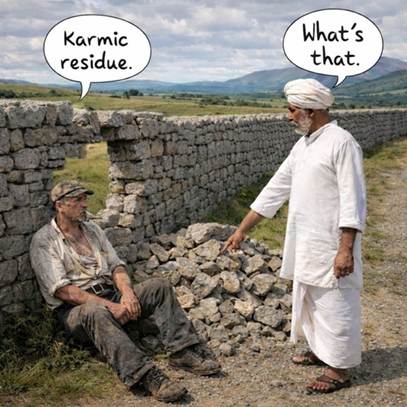
release,” illustrated by a wall, a gap, and a heap of stones 1) The scene as a diagram, not a story Treat the
Connemara wall as an ontology-model. Nothing “means” anything until it functions. ·
A dry-stone wall is a constraint-satisfaction
machine. ·
Stones are not symbols; they are units of fit. ·
Stability is not a belief; it is an achieved
configuration under gravity, friction, and geometry. In the
image, the crucial feature is not either man, but the gaping hole: a
visibly unresolved constraint in an otherwise coherent structure. The
adjacent heap of stones is stored potential that has not yet been
integrated. This is the whole druidic thought experiment in one glance: ·
Wall standing = achieved order ·
Gap = unachieved order ·
Heap = the backlog of potential
that remains because the gap remains The
conversation is therefore a diagnostic exchange about procedural state. 2) Ṛta: order as
operational coherence In the
early Vedic register, Ṛta (i.e. Rita) can be
read (without piety) as a name for reliability: the fact that the world
has repeatable regularities and that aligned procedures produce stable
outcomes. Procedurally,
Ṛta is not
“law” in the modern juridical sense. It is closer to: ·
the invariant constraints of a system, and ·
the coherence conditions under which events
remain stable enough to be identifiable. Examples
that match the Ṛta-intuition without importing
morality: ·
Fire: combustion is reliable
under certain conditions. ·
Seasonal recurrence:
ecological rhythms repeat with high regularity. ·
Ritual as technique: not
“pleasing a god,” but performing a sequence believed to couple correctly to
predictable outcomes (rain, fertility, social cohesion). In the
druid’s Procedure
Monism language: Ṛta is the procedural
grammar of emergence. The world is not first “things,” then “rules.” It
is “rules-as-consistent interactions,” from which things—stable
tokens—appear. So: Ṛta = the
system’s successful self-consistency. 3) The key transition: from cosmic regularity to
carried state Once “order”
is seen as procedural coherence, the next discovery is unavoidable: A system
can be locally coherent and still contain unresolved constraints. That is
exactly what the wall shows: long stretches stand perfectly, yet a gap
remains. This matters because it forces a conceptual upgrade beyond “order”
toward “history.” A
standing wall is not merely present structure; it is stored past fitting. This is
the bridge (so to speak) from Ṛta to karma:
the recognition that procedures leave remnants—carry-over—when not
fully resolved. 4) Karma, procedurally: carry-over of unresolved
alignment In the
operational register the druid has been building, karma is not cosmic
morality. It is persistence of constraint-load across iterations. Define
karma (non-mystically) as: ·
Karma = state that remains because a constraint
remains. ·
Residue = the physically/psychologically/socially
stored trace of incomplete resolution. Three
simple examples at increasing levels of abstraction: (A)
Mechanical example (your preferred register): (B)
Cognitive example: (C)
Social example: Across
all three: what persists is not “sin,” but unfinished fitting. 5) Why “residue” is the right word Residue
is what remains when a process reaches a local stopping point without
completing its full objective. ·
In chemistry: residue remains after reaction or
evaporation. ·
In computation: residue is leftover state—cached
values, unhandled exceptions, technical debt. ·
In construction: residue is literal—rubble,
offcuts, spare material, misfits. The wall
makes this literal. Dry-stone work has a known
procedural truth: You can’t
place every stone anywhere. Thus the heap is not “bad.” It
is selection pressure made visible. This is
why the labourer’s line works: “Karmic residue” is not an insult. It is a taxonomy. 6) The Brahmin as abstraction-layer, the labourer as
state-aware operator The image
stages a collision between two epistemic positions: ·
The labourer: inside the procedure, embedded,
dealing with constraints directly. ·
The Brahmin: above the procedure, conceptual,
classically trained, seeking meaning-objects. The
Brahmin points to the heap and asks “What’s
that?”—which is structurally the metaphysician’s move: reify the remainder
into a named entity within a theory. The
labourer answers “Karmic residue” in the only language that is actually
accurate at the worksite level: this is what’s left because the wall is
not finished. Notice
the non-judgemental logic: ·
The heap is not “evil.” ·
The labourer is not “guilty.” ·
The Brahmin is not “wrong.” They are
operating at different levels of description. The
druid’s thought experiment claims: later metaphysics often mistakes procedural
leftovers for moral ontology. 7) How Vedānta enters:
internalising Ṛta and
relocating the problem Vedānta (very broadly) performs a
major relocation: ·
From external order (world coherence) ·
to internal order (self
coherence) ·
and then to ultimate order (what is invariant
across all states). In
procedural terms, this is a legitimate move: what is asked is what remains
stable when everything transient is bracketed. But the
thought experiment flags a common by-product of that move: When
residue becomes primarily conceptual, it can detach from its original
operational meaning. In other
words: the heap turns from “worksite backlog” into “metaphysical burden,” and
the gap turns from “unfinished fitting” into “bondage.” A practical
description becomes a spiritual commodity. The image
resists that by keeping the residue literal: stones, gap, gravity, fatigue. 8) Moksha,
procedurally: release as closure, not escape In the
druid Finn’s register, moksha (i.e. liberation) is not
supernatural exit. It is release from constraint, meaning: the system
no longer carries the burden of the unresolved loop. Translated
into the wall-diagram: ·
Moksha is not “leaving the field.” ·
Moksha is the moment the wall no longer requires
a heap. When the
constraint is satisfied, the residue is consumed (integrated) or discarded
(no longer required). In either case: the system is no longer shaped by the
unfinished demand. Examples
in the same three tiers: (A)
Mechanical moksha: (B)
Cognitive
moksha: (C)
Social moksha: So moksha = closure
of a loop, yielding energy release and expanded degrees of freedom. In
the druid’s terms: release is a natural feedback of
successful resolution (i.e. perfect accomplishment) whereby the actual content of the accomplished function
is contingent. 9) Why rebirth becomes
thinkable (without asking you to believe it) Once
residue is framed as carried state, the question arises: how far can
carry-over extend? In purely
naturalistic systems, carry-over occurs across: ·
seconds (neural states), ·
years (habits), ·
generations (institutions), ·
evolutionary timescales (selected traits), ·
and cultural memory (texts, rituals, law). The
doctrine of rebirth is one historical
way of extending the carry-over horizon to its maximum: the idea that residue
does not “reset” at bodily death. You don’t
need to adopt that claim for the thought experiment to work. The point is
structural: A
carry-over model invites a long-horizon accounting scheme. The wall
already contains the minimal form of it: what you didn’t finish yesterday is
waiting today (or tomorrow), in a heap, by the gap. 10) The decisive claim of the druid’s thought
experiment The
thought experiment does not say “karma is false.” It says: Karma is
best understood first as a procedural category, not a moral one. ·
“Karmic residue” = leftover constraint-load. ·
“Punishment/reward” = later narrativisation
of the same mechanism for social control, pedagogy, or metaphysical
completeness. The image
forces the issue: you can watch residue accumulate without invoking ethics. Conclusion: the wall as compressed Vedic-to-Vedāntic genealogy The
Connemara wall is a better teacher than a thousand sermons. ·
Ṛta is the fact that the wall can
stand when built in alignment with constraints. ·
Karma is the fact that misfits
and incompletions persist as carried state. ·
Residue is the visible heap: stored
potential + unresolved fitting. ·
Moksha is the end-condition: the
loop closes; the heap ceases to be required. So when the Brahmin asks,
“What’s that?” the labourer’s answer is not mystical at all. It is the
only answer that respects the system: “Karmic residue.” |