|
The
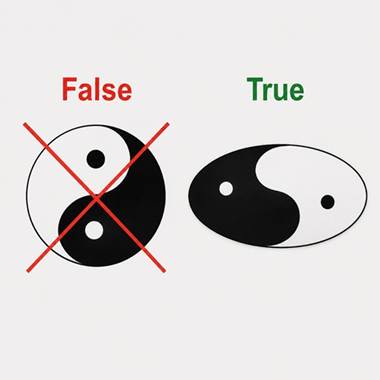
circular Yin–Yang as political fig leaf A ruthless reconstruction By the druid Finn
The
ordinary circular Yin–Yang symbol
presents itself as wisdom. Its message seems gentle: opposites belong
together; conflict returns to balance; darkness contains light; light
contains darkness; change is cyclic; the world is whole. At first sight, it
is elegant, humane, and psychologically consoling. But that
is precisely the problem. The
circular taijitu is not merely a symbol of
polarity. It is
a symbol of managed
polarity.
Its circle encloses tension, domesticates opposition,
and converts conflict into harmony. The result is not a true diagram of
change, but a political diagram of reassurance. Its
silent message is: Nothing
finally changes. Everything returns. Stay calm. Stay inside the circle. That is the fig leaf. If Yin and Yang are
genuine polarities, then their true symbolic form should not be circular. A
circle implies perfect return, closure, conservation, and equilibrium. Every
point is held within the same unbroken containment. It is the geometry of
order. But polarity is not
circular. Polarity
creates tension. Tension creates displacement. Displacement creates change.
Change produces uncertainty, reversal, collapse, emergence, and historical
movement. The proper symbol of such a process is therefore not a closed
circle but an ellipse: stretched, directional, unstable, foci-driven. The
ellipse says what the circle suppresses: Polarity does
not merely balance. Polarity produces transformation. That
distinction is politically explosive. A
circular Yin–Yang tells the
peasant, the official, the soldier, the widow, the defeated faction, and the
exploited labourer that apparent disorder is only part of a greater harmony.
It aestheticizes suffering. It transforms social contradiction into cosmic
complementarity. It says: this too belongs. The
ellipse says the opposite. It says: tension moves. Power shifts. Fortune
reverses. What dominates now may decay. What is suppressed now may return. No
order is final. That message is dangerous to authority. The
circular symbol therefore functions as political cosmetics. It does not deny
change outright; that would be too crude. Instead, it absorbs change into a
reassuring closed form. Change becomes recurrence, not rupture. Opposition
becomes complementarity, not conflict. History becomes circulation, not
transformation. This is the confidence trick. The
line-output (thus point) of the circle is political
flatness: artificial order (AI) restored, hierarchy preserved,
contradiction neutralised. The wave-output of the ellipse is politically
unacceptable because it displays real, meaning natural (NI) becoming: oscillation, imbalance,
instability, and reversal. The
circle is what power, the elite in control, wants (managed) change to
look like. The
ellipse is what change actually, meaning naturally
does. From the
standpoint of Procedure
Monism, the flaw is decisive. Real emergence does not arise
from decorative harmony, but from constrained differentials, polarity,
tension, collision, asymmetry, and output. The traditional circular symbol
shows polarity without cost. It shows opposition without violence. It shows
transformation without mechanism. It is therefore not a true engine-diagram.
It is a stabilising icon that is intended to deceive. Its
genius lies in that deception: it appears profound because it includes
opposites, but it neutralises them by enclosing them inside a perfect whole. That is
why the circular Yin–Yang is
politically useful. It is a metaphysical pacifier. It gives the ruled an
image of balance and gives the ruler an image of legitimacy. The
ruthless conclusion is this: The circular Yin–Yang symbol is
not the true sign of change. It is the political, hence artificial (AI) containment
of change. It is a fig leaf over natural (NI) instability, a cosmetic over raw power, and a
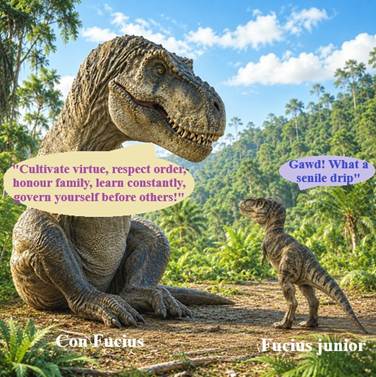
confidence trick dressed as cosmic wisdom. ADDENDUM The
Confucian fig leaf (i.e. as establishment self-preservation propaganda)
Since, as the Finn druid said: “The right way is the untrodden. It becomes the wrong way when
you’ve stepped on it!” |