|
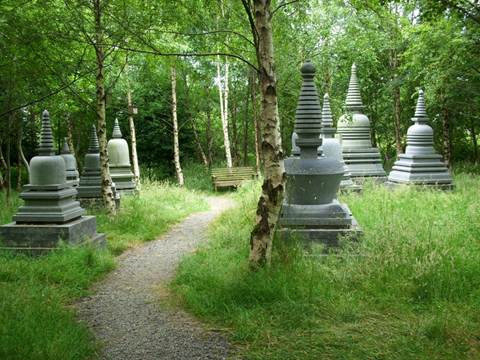
The Druid Finn’s Nemeton in Mullinaveigue,
Co Wicklow, Ireland (closed to the public) A Contemplative Hermitage
The old Celtic nemeton was a
place set apart—a grove or enclosure where behaviour changed because the
boundary had been drawn. Finn keeps that structure but strips the story. No
spirits, no metaphysics, no sanctity, no priestly privilege. What remains is
the mechanism: mark a specific boundary, adapt (or adopt) the rules inside
it, and observe and analyse altered responses. In Mullinaveigue, Co Wicklow that
boundary, thus perspective, defines a working hermitage—a monastery
for one contemplative. A modern druid nemeton is not a
retreat for consolation, but a disciplined environment (akin to jnana yoga) for
severely focused observation and analysis The purpose of the nemeton is not to
feel different; it is to see more cleanly. Inside the boundary, the
task is simple and severe: reduce noise (as
in Patanjali’s Yoga Sutra N0 2) until the generating rules
of experience, indeed of emergence as such, show themselves. Where the older nemeton hosted
offerings and rites, Finn’s modern adaptation replaces ritual performance
with methodical, discrete observation and analysis. The daily “practice” is not worship but data constraint:
suspend (essentially
cosmetic) metaphysical
assumptions, refuse decorative explanations, and track only what can be
observed as change, interaction, or limit. If a notion does not improve
resolution, it is dropped. If it stabilizes a clearer read (of the structure and function, as substrate of) of events, it is provisionally kept. That’s the whole
discipline. The nemeton
functions as a personal field laboratory with minimal variables (meaning assumptions). The rural Wicklow setting helps: fewer signals, slower cycles, repetitive
patterns—light and dark, weather, bodily rhythms, cheap cigars. With less
interference, hence greater sensitivity, marginal effects stand out. You begin to notice (akin
to early Buddhist satipatthanasati practice) the basics: discrete contacts, response thresholds,
feedback, and how repetition builds what is later called “identity.” You also
see, quite plainly, how quickly the mind (as
personal dashboard) paints over the massive raw data flow with a
user-friendly surface—stories, meanings, “why.” Those analogue overlays (of digital raw data) are
useful, but within the nemeton treated
as (expedient but distracting) cosmetics—personal
renderings (akin to survival props, like lipstick) to be
bracketed so the underlying emergence procedure can be inspected.
Makeshift nemeton So the nemeton
becomes a constraint-field (akin to an experimental set) for
cognition (or contemplation). Inputs are whatever the environment and body
present. Constraints are deliberately chosen limits on attention and
interpretation. Outputs are clearer models of emergence—how, and to
what end “world,” “self,” and “meaning” get assembled from events. In Finn’s
terms, it’s a local sandbox of the Universal Procedure: tighten the
frame, watch the transduction. What used to be “taboo” is now just loss of
resolution. Drift back into vacuous metaphysical placeholders—“essence,” “spirit,” “ultimate”—and the signal blurs.
Hold the line on what changes, what constrains, what feeds back, and the
picture sharpens. No piety required, just operational discipline. |