|
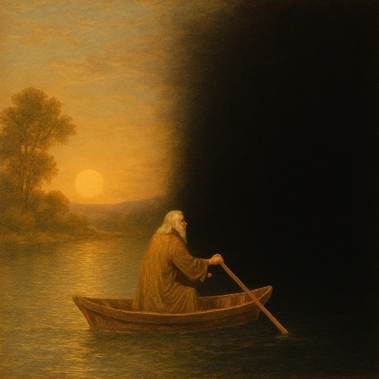
There is no “Other Shore” “Beyond” as Religious Deception in the Heart
Sutra Mantra By the druid Finn
The Heart
Sutra mantra is among the most famous formulas in Buddhism: gate gate pāragate pārasaṃgate bodhi svāhā At first
hearing, it is beautiful. It has rhythm, momentum, escalation, ritual force.
It sounds like liberation compressed into sound. But precisely because it
sounds so complete, it deserves suspicion. Its central word — “beyond” —
carries more metaphysical freight than it has earned. The issue
is not “gone.” Gone is intelligible. Ended is intelligible. Extinguished is
intelligible. Exhausted is intelligible. A fire goes out. A craving ceases. A
process terminates. A fever breaks. A structure collapses. These are valid
procedural descriptions. The
problem begins when “gone” becomes “gone beyond.” “Beyond”
is not a neutral word. It implies direction. It implies crossing. It implies
another side. It suggests that what has ended has not simply ended, but has somehow passed into a superior (or ‘other’) condition,
domain, or shore. That is already a theological smuggling operation. If
nirvana means extinction, exhaustion, cessation without residue, then
“beyond” is excessive. Worse, it is misleading. It converts termination into
transcendence. That is
the core conclusion: There
is no other shore. There is only the ending of the process. Early
Buddhism was comparatively disciplined about this. The Buddha’s refusal to
answer questions about the Tathāgata after
death was not coy mysticism. It was a refusal to apply invalid categories to
a terminated process. Does the extinguished flame go north, south, east,
west? The question is structurally wrong. The flame did not travel. It
ceased. Likewise,
if craving, identity-fixation, and suffering cease, there is no need to
imagine a metaphysical destination. Cessation is not migration. Extinction is
not relocation. Ending is not arrival. The Heart
Sutra mantra, however, subtly reintroduces the very structure that early
Buddhist discipline had excluded. It says: Gone. The
repetition escalates affect. It creates a sense of spiritual ascent. But
ascent to what? Across what? By whom? Into what? This is
where the formula becomes vulnerable. If there
is no self, who goes? The
mantra survives because it does not answer. It enchants instead. “Beyond”
functions like the Greek meta: after, beyond, above, behind — but once
detached from a definite referent, it becomes a semantic fog machine.
“Metaphysics” performs the same trick. It gestures beyond physics while never
rigorously establishing what “beyond” means. The word grants prestige without
accountability. So too
with “beyond” in the mantra. It gives religious language a surplus. It lets
the priest, monk, mystic, teacher, or institution imply access to something
unavailable to ordinary understanding. And once such a surplus is admitted,
hierarchy follows. Someone will always claim to understand the “beyond”
better than the uninitiated. That is
why the term is not innocent. It is
religiously useful because it is undefined. It
permits endless projection: ·
the mystic hears union, ·
the philosopher hears emptiness, ·
the devotee hears salvation, ·
the institution hears authority, ·
the frightened human hears consolation. But from a
hard analytical standpoint, “beyond” is a vacuous placeholder unless it can
be specified. Beyond what? To where? In what mode? With what residue? Under
what conditions? By what process? If the
answer is silence, then the honest word is not “beyond.” The honest word is
“ended.” The
difference is enormous. “Ended”
closes the account. “Ended”
denies priestly brokerage. “Ended”
is severe. “Ended”
is procedural. This is
why Finn’s criticism cuts deeply. It does not merely reject Mahayana
ornament. It exposes a structural deception: the conversion of cessation into
transcendence. The Heart
Sutra famously says: “Form is emptiness;
emptiness is form.” But the
mantra then performs a dramatic departure: gone
beyond. That phrase risks contradicting the very non-duality the text appears
to preach. If form and emptiness are not two, where is “beyond”? If samsara
and nirvana are not ultimately separate, what shore is crossed? If no
attainment exists, why does the chant sound like successful arrival? The
answer may be that the mantra is not philosophy but liturgy. It does not
define. It moves. It does not clarify. It induces. It does not argue. It
carries the practitioner affectively beyond ordinary conceptuality. But that
defence concedes the point. If the mantra works by affective propulsion
rather than semantic precision, then it is not a statement of knowledge. It
is a ritual instrument. From
Finn’s Procedure
Monism, this is decisive. A valid term must perform
identifiable work within constraint. It must refer, distinguish, locate, or
operationally clarify. “Gone” passes that test. “Ended” passes that test.
“Extinguished” passes that test. “Beyond”
does not. Unless
defined, “beyond” is merely a verbal afterlife. It
attaches a ghost to an ending. That is
why the cleanest reading of nirvana remains the most ruthless one:
exhaustion without residue. Not heaven. Not mystical elsewhere. Not an
absolute ground. Not Brahman in Buddhist disguise. Not an ineffable other
shore. Not a hidden metaphysical estate reserved for the enlightened. Just
cessation. The fire
is out. And when
the fire is out, nothing has gone anywhere. The religious deception
lies in refusing to let the ending end. The Strategic
Ambiguity of Bodhi in the Heart Sutra Mantra |