|
The druid said: Traffic generates saints
1. What the Scene Depicts (Operationally, Not
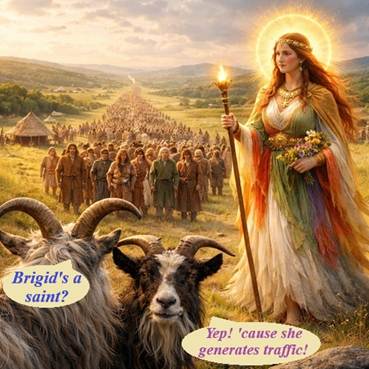
Theologically) The image
stages a familiar socio-ecological pattern: ·
A radiant figure (Brigid) = a
salient attractor in an attention economy. ·
A vast crowd moving toward her = mass
convergence around a focal point (i.e.
a gravitational field). ·
Goats in the foreground =
detached, non-participating observers embedded in the same ecology but not invested in the
belief system. ·
Halo, glow, colours = signal
amplification (visual markers of importance). Nothing
supernatural is required to explain the phenomenon. The scene is a traffic
generator event: 2. The Causal Chain Behind “She’s a Saint” The
category “saint” is not an ontological discovery. Causal
sequence: 1. A figure
becomes a high-visibility node (ritual, myth, narrative, spectacle). 2. Bodies
aggregate (pilgrimage, crowds, mass, circulation). 3. The
aggregation (as mass) is
retrospectively interpreted as proof of sanctity. 4. Sanctity
is then used to justify further aggregation. So: Traffic
→ Sanctity label The goats
intuit the correct causal direction. 3. Why the Second Goat’s Line Is the Logical Ground “She’s a
saint” “’cause she generates traffic” The
second goat supplies the mechanism that the first goat mystifies. In plain
terms: ·
Saints, gods, gurus, relics, temples, and icons ·
Their “holiness” is a reputation effect of
crowd formation. ·
The halo is not a metaphysical property; 4. The Naturalistic (druidic) Rule
Being Exposed This
image compresses a general rule of social systems: Where
bodies converge reliably, prestige emerges. Or in
procedural terms: ·
Repeated convergence → stabilised reference
node ·
Stabilised reference node → symbolic
elevation ·
Symbolic elevation → narrative of holiness The goats
are not being cynical for humour’s sake. 5. Final Compression (the goats’ theorem) Nothing
is holy first. (It becomes whole, real and
identifiable by interacting). |