|
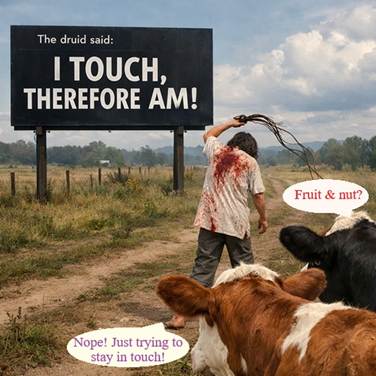
The druid said: Touch is the Boundary A Collision Ontology of
Being By Victor Langheld
1. From Substance to Interface Medieval metaphysics—from
René Descartes to substance monism to Kant—assumes that entities possess
intrinsic identity (already rubbished by the Buddha in 400BC) and interaction is secondary. The druid’s proposition
reverses this: There are
no pre-given entities—only boundaries, and boundaries only exist at points of
contact. “Touch”
is not a bridge between two already-existing things. In physics, this is not
speculative. At the
atomic level, “touch” is electromagnetic repulsion—no surfaces ever meet;
they define each other through resistance. Without this repulsion,
there is no edge, no form, no object. Thus: ·
No touch → no boundary ·
No boundary → no identity ·
No identity → no “thing” Identity
is not a noun. It is a collision event. 2. Geometry of Relation: Boundary as Dynamic Surface If touch
defines boundary, then relationships are not connections but continuously
updated edge-maps. To “stay
in touch” is not to maintain a link—it is to continuously redraw the
perimeter between self and other. Example: Friendship Two
friends who speak daily: ·
Their boundaries are high-resolution ·
Differences are constantly registered
(preferences, moods, reactions) ·
The relationship has shape Two
friends who do not speak for years: ·
Their model of each other becomes low-resolution
·
The boundary dissolves into memory abstraction ·
The “other” becomes a simulation, not a
contact-defined entity Thus: Relationship = active boundary maintenance system 3. Touch as Measurement: The Pressure Model Every
interaction is a force test at the boundary.
Example: Argument A
disagreement is not a failure of connection—it is: a
high-pressure measurement of where one boundary ends and another resists If no
resistance occurs, one of two things has happened: 1. The
boundary is weak (collapse) 2. The
boundary is avoided (withdrawal) The druid
said: “Pressure
makes real” 4. Biological Analogy: Touch as System Orientation Organisms
(like the blind man) rely on proprioception—the sense of where the
body is in space. Extend
this socially: “Staying
in touch” = social proprioception Without
it: ·
You lose calibration of others ·
You lose calibration of yourself relative to
others Example: Isolation In
prolonged isolation: ·
No feedback loops ·
No boundary reinforcement ·
Self-model begins to destabilise This is
why isolation is not merely unpleasant—it is ontologically corrosive. 5. The Digital Failure: Touch Without Resistance Digital
interaction introduces a critical anomaly: Touch
without reciprocal force You can: ·
View ·
Like ·
Scroll But
receive: ·
No resistance ·
No pushback ·
No boundary confirmation This
produces phantom contact. Example: Social Media You
“engage” with 500 people: ·
But receive minimal or no response ·
No measurable resistance occurs Result: You
simulate touch, but no boundary is located This
creates: ·
Ghost relationships (as with Reddit) ·
Inflated sense of connection ·
Actual boundary erosion 6. Ontology: “I Touch, Therefore I Am” This is
the decisive shift beyond Descartes. Descartes: “I think,
therefore I am” → existence is internal certainty Your
formulation: “I touch,
therefore I am” → existence is externalised collision Implications: 1. Self is
surface, not depth o There is
no hidden essence o Only
boundary interactions 2. Existence
requires opposition o The
“Not-You” is not secondary—it is constitutive 3. Being is
event-based o Each
contact = momentary instantiation of identity 7. Loss of Touch = Loss of Being If
existence is boundary-defined, then: Non-response
is not absence of communication—it is deletion of boundary Example: Ignored Message ·
A message sent is a “ping” ·
No reply = no return signal ·
The coordinate collapses This is
experienced as: ·
Anxiety ·
Disorientation ·
Loss of relational reality At scale,
this explains: ·
Loneliness ·
Social fragmentation ·
Identity instability 8. Quality of Touch = Quality of Being Not all
touch generates the same ontology.
Example: Healthy Dialogue ·
Both sides exert and receive pressure ·
Boundary oscillates but holds Result: A (simulated) shared
reality emerges at the interface 9. Staying in Touch as Ontological Maintenance This is
the most operational insight. We do not
stay in touch: ·
to exchange instruction (sequenced as information) ·
to be polite We stay
in touch: to
continuously re-render our boundaries in real time Example: Long-Term Relationship If two
people stop interacting: ·
Their internal models diverge ·
When they meet again: o Boundary
mismatch occurs o Recalibration
is required Thus: Every
interaction/touch is a “handshake protocol”
updating the system state 10. The Druid’s Conclusion ·
Touch is not connection ·
Touch is definition ·
Identity is not possessed ·
Identity is an impact measurement ·
Relationship is not continuity ·
Relationship is repeated boundary resolution
·
Existence is not internal ·
Existence is collision-dependent The New Cogito I am my
responses to the resistances I encounter. Or in its
most compressed form: Touch is
the boundary. |