|
The Sri
Yantra as vacuous placeholder By the druid Finn
1. What the Śrī
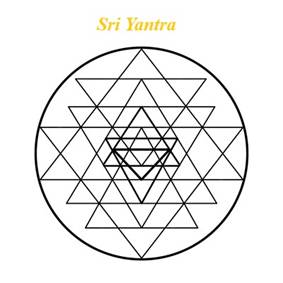
Yantra Is (Formally, Not Devotionally) Śrī Yantra (Śrī Cakra) is a complex geometric
diagram used in Śākta Tantra, composed
of: ·
9 interpenetrating triangles (4
upward = Śiva, 5 downward = Śakti) ·
43 subsidiary triangles ·
Concentric enclosures (lotus
petals, circles, square bhūpura) ·
Bindu (central point or void) Textual
traditions claim it “represents”: ·
the structure of the cosmos, ·
the body of the Goddess, ·
stages of consciousness, ·
and the path to liberation. Crucially,
none of these referents is uniquely or technically specified. The
yantra is said to be “that which cannot be spoken,” while simultaneously
being treated as a total cosmogram. This
already signals placeholder logic. 2. Vacuous Placeholder: Technical Definition
(Non-mystical) A vacuous
placeholder (as variable orientation means) is a symbol or construct that: 1. Occupies
an explanatory or integrative position 2. Without
supplying determinate content 3. While
remaining indefinitely re-interpretable 4. And
socially insulated from falsification The Śrī Yantra qualifies on all four counts. 3. How the Śrī
Yantra Functions as a Vacuous Placeholder 3.1 Non-Referential Overloading The Śrī Yantra is claimed to encode simultaneously: ·
ontology (structure of reality) ·
cosmology (universe model) ·
psychology (mind-states) ·
soteriology (liberation path) ·
theology (body of the Goddess) ·
ritual technology (instrument of power) Yet no operational
mapping rules (or references) are
provided that would let one verify any of these claims. This is
classic symbolic overloading without constraint grammar. The
yantra functions like a blank variable X onto which any metaphysical
content can be projected. 3.2 The Bindu as Pure Placeholder The bindu (central point) is said to be: ·
source of all manifestation ·
transcendence and immanence ·
void and fullness ·
subject and object ·
Śiva and Śakti
united ·
beyond thought But the bindu is never defined operationally. The bindu therefore functions as: a terminating
symbol for inquiry — a place where explanation stops. This is
structurally identical to: ·
“the Absolute” ·
“pure consciousness” ·
“God” ·
“the Dao” ·
“substance” ·
“the One” All are terminological
stopgaps for explanatory exhaustion. 3.3 Ritual Insulation from Falsification The Śrī Yantra is protected by: ·
initiatory secrecy ·
esoteric exegesis ·
hierarchical transmission ·
claims of ineffability ·
soteriological authority (“works if done
correctly”) This
creates epistemic closure: ·
If results occur → yantra works ·
If results don’t occur → practitioner
impure / method incorrect / insufficient devotion Thus the
symbol is functionally unfalsifiable, which is a hallmark of vacuous
placeholders. 3.4 Diagram as “Cosmic User Interface” The Śrī Yantra operates as a visual totaliser: ·
It gives the impression of formal precision
(geometry, symmetry, nested order) ·
While lacking any executable semantics This
creates a cognitive illusion of explanatory depth: “Because
it looks precise, it feels precise.” But no
rule exists such as: “Triangle
A corresponds to X measurable process; removing it yields Y detectable
change.” The
geometry is aesthetic formalism, not a functional model. 4. Psychological and Cultural Utility of the
Placeholder Calling
the Śrī Yantra a vacuous placeholder does
not mean it is useless. 4.1 Cognitive Compression It
compresses: ·
cosmology ·
theology ·
ethics ·
ritual This
lowers cognitive load and stabilises belief systems. 4.2 Attention Training & Psychotechnics Meditation
on the yantra: ·
structures attention ·
induces and trains absorption (i.e. contemplation) ·
stabilises focus ·
produces altered states But these
effects arise from neurocognitive entrainment, not from any
demonstrable ontological mapping between triangles and reality. The
yantra works as a psychological instrument, as a training means, like a punching ball, not as a metaphysical diagram. 4.3 Social Authority Technology Possession
of the “true interpretation” of the Śrī
Yantra: ·
legitimises priestly power ·
justifies guru authority ·
creates hierarchy of insiders vs outsiders The
placeholder (just like Shankara’s vacuous placeholder Advaita) supports institutional control by remaining
undefined while symbolically total. 5. Comparative Critique: Diagrammatic Absolutes Across
Cultures The Śrī Yantra belongs to a family of totalising
placeholders:
All
share: ·
semantic indeterminacy ·
explanatory authority ·
immunity to refutation ·
symbolic totality The Śrī Yantra differs only in being graphical
rather than verbal. 6. Core Critique: Why the Śrī
Yantra is vacuous at the Ontological Level The
decisive critique is: The Śrī Yantra does not specify a generative
mechanism. It
offers: ·
no causal rules ·
no transformation laws ·
no constraints on interpretation ·
no falsifiable claims ·
no predictive power Therefore: It is not
a model of how reality emerges, It is
structurally analogous to a mandala of meaning: 7. Final Compression (Critical Verdict) The Śrī Yantra functions as a vacuous placeholder: ·
A visually precise symbol ·
Carrying, i.e.
suggesting metaphysical totality ·
Without operational semantics ·
Serving as a cognitive, ritual, and institutional
stabiliser/trainer ·
While terminating inquiry rather than advancing
explanation Its power
is psychological and sociological, In short: The Śrī Yantra does not explain reality. It’s
primary function is to train absorption (as
escape from Samsara). It aestheticises ignorance and ritualises
projection—beautifully, effectively, and without constraint. |