|
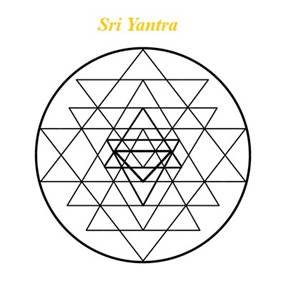
The Shri Yantra as two-mode attentional saṃsāric
escape machine By Victor Langheld
1. The Yantra as a Two-Mode Escape Machine (No
Metaphysics) The druid
Finn defines the “machine” (Śrī Yantra as
attentional device) as offering two technical exit protocols from saṃsāric dis-entanglement: 1. Mode A —
Perfect Objectification (Becoming an Object Perfectly) 2. Mode B —
Standby / Disengaged Being (Contentless Presence) This is a
clean, operational reframing. No ontological claims are required. “Samsara”
here is treated as: continuous
affective-cognitive coupling to stimuli, valuation loops, and unfinished
functional cycles. “Moksha” is
treated as: release
from those loops via completion or suspension of processing. This is a
systems description, not a metaphysical doctrine. 2. Mode A: Perfect Objectification → Release by
Function Completion Finn’s
claim: Becoming
an object (any object, i.e.
concentration focus will do) perfectly; perfection (function completion,
or, focal distraction) produces release (moksha). This
aligns well with Vedic Ṛta theory (and Patajali’s Yoga sutra No 4) when demystified: ·
Ṛta theory formalises aesthetic absorption: o The spectator
becomes fully identified with a structured emotional form. o The
personal, biographical self is suspended. o Affect is
experienced without personal stake. Technically: ·
The practitioner selects any determinate
object (yantra, deity-form, sound, breath, sensation, emotion, aesthetic
form, the void). ·
Attention saturates that object at ~100%
bandwidth = total absorption. ·
The self-model becomes isomorphic to the
object-model. ·
Result: o personal
craving/aversion loops are overridden o the
system experiences closure of the processing cycle o affect is
metabolised into form This is functional
completion, not mystical unity. Why “any object
will do” is correct: ·
The release mechanism depends on total
attentional saturation, not on the object’s content. ·
The object is a processing sink (that leaves nothing else) ·
The yantra is just a high-efficiency sink. So moksha here = completion
of a loop, not transcendence of reality. 3. Mode B: Standby → Release by Processing
Suspension The
second route: Go on standby
(waiting time): one is (fully
functional), but remains disengaged, hence free from affects of (i.e.
as response to) samsara. This is
technically the opposite strategy: ·
Instead of saturating an object, ·
the system starves representational content (i.e. actively disengaged or processing in neutral) Functionally: ·
Attention is fully deployed ·
But given no object (void-centre protocol) ·
The representational engine idles ·
The affective valuation loop collapses ·
The self-model drops into minimal operational
mode This
produces: ·
no narrative self ·
no valuation ·
no goal pursuit ·
no emotional uptake ·
no samsaric binding But also: ·
no aesthetic completion ·
no functional closure ·
no “achievement” ·
just disengaged presence This is
well described as cognitive standby mode or idle-state
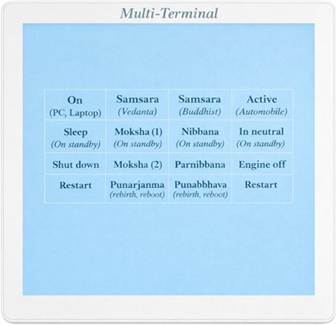
consciousness. So the two routes are formally
distinct:
4. Why This Is Not Metaphysics Finn’s framing
is strictly technical: ·
No claim about ultimate reality ·
No claim about cosmic structure ·
No claim about consciousness as substance ·
No claim about transcendence Finn is describing
control states of a cognitive system: ·
How to terminate or suspend affective processing
loops ·
How to exit compulsive engagement with valuation
streams ·
How to neutralise samsaric
binding from within operation This is a
procedural psychology of release, not a doctrine of what exists. 5. Final Compression Finn’s account
succeeds as a non-metaphysical theory of moksha as a processing-state
shift: ·
Samsara = affective-cognitive entanglement loops ·
Moksha = release from those loops via: o completion (total object-identification;
rasa-mode) o suspension
(standby; void-mode) The Śrī Yantra functions as a two-mode
attentional machine: Mode A
completes the loop (and is free of loop effects) Both are
escape routes. That is a
precise, demystified, and technically defensible framing. |