|
Two Standpoints, One Reality Dualist scarcity vs monist
abundance in the ‘Way’
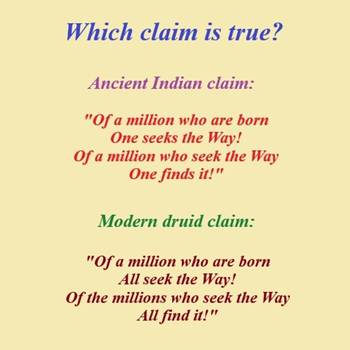
1. The Two Claims Are Not Competing Facts – They Are
Two Different Standpoints They do
not disagree about reality; they describe the same situation from two
incompatible vantage points: ·
Ancient Indian claim → external,
selection-based perspective ·
Modern druid claim → internal,
identity-based perspective The
conflict is not empirical. It is structural and epistemic. 2. Ancient Indian Claim “Of a
million who are born Perspective: Observer-of-the-population This
claim adopts the standpoint of: ·
priest ·
sage ·
tradition ·
institution ·
census-taker of enlightenment Structural assumptions: 1. The Way
is rare 2. Hierarchy
of spiritual success o most are
ignorant o fewer
seek o almost
none succeed 3. Scarcity
legitimises authority o gurus are
necessary o intermediaries
gain power o doctrines
gain gatekeeping authority 4. External
validation model Functional role: This
claim supports religious economy: ·
creates spiritual elites ·
justifies long training regimes ·
stabilises priestly authority ·
sustains hope by scarcity (“you might be the
one”). In Finn’s
vocabulary: 3. Modern Druid Claim “Of a
million who are born Perspective: Inside-the-system / identity-based This
claim adopts the standpoint of: ·
the emergent itself ·
the token of the procedure ·
the instance of the universal constraint-set Structural assumptions: 1. Seeking
is not optional o stabilising o orienting o self-maintaining o resolving
constraints So
“seeking the Way” is simply: the automatic
activity of any system trying to remain itself. 2. Finding
is tautological o to exist
= to already be the Way in operation o to
function = to instantiate the Way o to
persist = to “find” operational closure No metaphysical
achievement is required. 3. No
priestly bottleneck ·
no gate ·
no transmission ·
no certification ·
no elite class of “finders” Each
emergent is already the local solution of the universal problem of
existence under constraint. 4. The Way
is not a destination ·
not a hidden object ·
not a mystical state ·
not an attainment Hence: All who
seek find – because seeking is identical with functioning. 4. The Real Difference: External Census vs Internal
Identity
5. Why the Ancient Claim Feels Plausible (But Is
Structurally Wrong) The ancient
claim feels true because: ·
humans compare themselves socially ·
spiritual traditions track behavioural conformity ·
“enlightenment” is confused with: o discipline o social
recognition o ritual
fluency o doctrinal
correctness So the population-level
optics create the illusion of rarity. But
rarity of performance is confused with rarity of being. The
druid’s framework cleanly splits these: ·
Application success is rare ·
Existence as successful iteration is universal The
priest mistakes application proficiency for ontological access. 6. The Druid’s Final Compression The
ancient saying is not false — It speaks
from: the bookkeeping
perspective of institutions. The
modern druid speaks from: the
operational perspective of existence itself. The
priest counts outcomes. From the
outside: One in a
million appears to “find the Way.” From the
inside: Every one who
exists already is the Way finding itself. The
difference is not spiritual. |