|
“Right
Act, Wrong River” Deconstructing the Ganges Bath as Symbolic Closure vs.
Real Function Completion By Victor Langheld
1) The image as a compressed argument The
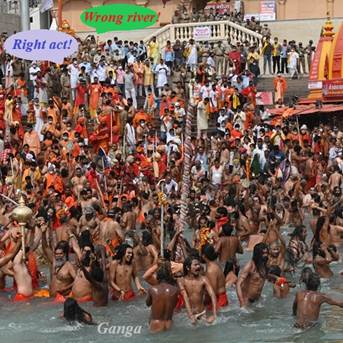
photograph is doing more than depicting a festival bath on the Ganges. Once
you add the speech bubbles, it becomes a logical diagram: ·
“Right act!” affirms the form of
the practice: immersion/enactment/reset. ·
“Wrong river!” denies the metaphysical
attribution: the Ganges as an intrinsically purifying interface. ·
The caption “Ganga” pins the critique to a
specific branded sacred object. So the image already contains
a distinction that drives our analysis: A
procedure can be functionally apt while the metaphysics that justifies it is
misassigned. That is
the key move: separate operational efficacy from story-level
causality. 2) Genealogy: why “wrong river” is not a cheap sneer
but a historical claim Our timeline
logic: 1. Ṛta (Vedic regime): order is
maintained by correct participation in invariants. There is no canonical
“holy river that cancels liability.” 2. Karma–mokṣa problem-space (Upaniṣadic
shift): the universe becomes morally/accountably legible; a
debit/credit logic appears. 3. Tīrtha technology (Epic/Dharmaśāstra, Bhakti populism):
pilgrimage, expiation, and merit become standardized interfaces. 4. Purāṇic
saturation: Gaṅgā becomes the
supreme purifier and post-mortem facilitator. In other
words, “wrong river” means: the river-as-soteriological-clearinghouse
is a later (populist) interface layered onto an earlier (un-emotional) jnana
order-logic. The
critique is not “people are silly,” but “a specific metaphysical function was
historically installed to satisfy popular need.” 3) What “right act” means in our analysis: immersion as
enacted state grammar The image
supports a crucial point: ·
The act of immersion is a hard, embodied
threshold crossing: o stepping
out of routine o exposing
the body to cold/current/crowding o submitting
to a non-negotiable constraint field (water, gravity, risk) ·
In systems terms it reads as a state
transition ritual (a “reset gesture” in the agent’s local control loop). This is not
a change in the Universal Procedure, only a local phenomenal / behavioural
reconfiguration. That correction matters: Enactment
doesn’t change reality’s engine; it changes the agent’s stance inside
it. So “right
act” = a procedurally meaningful gesture because it recruits
constraint, cost, and commitment. 4) “Wrong river” as placeholder capture: the monopoly
problem Enter the
“placeholder” as survival Universal Instantiation (i.e.as fiction “as if” fact). The
Ganges, in this reading, is a classic case of placeholder capture: ·
A generic, widely useful function exists: reset / closure / purification-feeling /
recommitment ·
The function is then attached to a particular
token (Gaṅgā-as-placeholder) ·
The token becomes a branded exclusive
interface: o purification
is “here” o merit is
“here” o auspicious
death is “here” o ancestral
repair is “here” So “wrong
river” means: the river
is treated as cause when it is merely a culturally stabilized terminal. This is
why the analysis and critique is structural rather
than theological: it targets an interface architecture. 5) The category error: mortality vs soteriology Correction
the category error is central to the whole Ganges analysis: ·
Mortality is biological/ontic
(organisms die). ·
Release is
soteriological/accounting status (rebirth liability, auspiciousness,
clearance). The
Ganges cannot alter mortality. What it can do—within the belief system—is
alter interpretation and bookkeeping around death. So the image can be read as a
visual form of the same correction: Bodies
still die; the story changes what death means. 6) The upgraded framework: the universe as ensemble of quantised
placeholders The fantasy
that “we can remove placeholders” is refused. Thus the meta-axiom: All
identities are lastly metaphors; the universe happens as quantised transient
interaction; discourse is impossible without tokens (i.e. quanta). That
forces a more precise reading of “wrong river.” It can’t mean “stop using
metaphors.” It means: use
metaphors knowingly, and do not confuse the (or any) Universal
Instantiation (i.e. the output-as-elaboration) with the engine (i.e. the transducer-as-fractal). So the critique becomes epistemic
hygiene, not iconoclasm. 7) Purity, redefined: not moral essence but
differentiator The “purity”
smuggling value is neutralized: ·
“Pure” is not an intrinsic moral property. ·
It is a local discrimination label
required for interaction/communication. ·
“One-to-one is pure” = each iteration is complete
as an iteration (i.e., @c² framing). This
reframes the bath: ·
The bath is “purifying” only insofar as it marks
a boundary (before/after, inside/outside, aligned/misaligned). ·
The “purity” is a control tag—a way for
the organism/system to stabilize behaviour. So the image’s “Right act!”
can be read as: “yes, boundary-marking via enactment is a valid control
move.” 8) Moksha, redefined: not transcendence, but
ending/standby Salvation
is replaced with termination logic: ·
mokṣa (liberation)
= ending, period (death or on-standby) Under
that definition, the Ganges bath becomes transparently what is later called: “a
symbolic infantile ‘as
if’ completion.” It
simulates “ending/closure” without necessarily closing the real loop. 9) The decisive move: “Samsara is the real Ganges” The final
assertion flips the entire icon: ·
The “Ganges” as holy cleanser is a false
cleansing operation (a conversation-level decoy introduced to eliminate). ·
The real “river” is Samsara (to wit, actual everyday
existence) itself: the
ongoing creative stream of instantiation (i.e. the Saguna Brahman). So: ·
Infant bath: wash in the symbol to feel
complete. ·
Adult bath: complete one’s function within
the ‘as-is’ stream; closure occurs by loop-completion, not by symbolic
substitution. This is
the culmination of the image logic: They go
to the river to be cleansed, while the deeper truth is that they are
already the stream, and cleansing equals competent (self-) completion
within it. 10) Concrete examples from our chat, mapped to the
image Example A: “Right act / wrong river” ·
Right act = enactment under constraint (immersion
as boundary marker). ·
Wrong river = misattributed metaphysical
causality (river as exclusive purifying engine). Example B: Bookkeeping invention ·
The crowd behaves as if purification is a clearinghouse
transaction. ·
Our analysis says that clearinghouse logic is
historically installed; The Ṛta of Veda doesn’t
require it. Example C: Infantile “as if” vs adult “as is” ·
Infantile: simulate completion via sacred token. ·
Adult: complete actual function; Samsara is the
only real river. Example D: Placeholders are unavoidable ·
The image speech bubbles themselves prove the point:
even the critique needs symbols. ·
The goal is not symbol
removal but symbol demotion (UI ≠ engine). 11) Conclusion: what the image ultimately argues (in
Finn-compatible terms) The image
is a critique of mislocated efficacy. ·
Immersion works (locally) because it is a costly
enactment that tags a state boundary. ·
The Ganges is “wrong” only insofar as it is
treated as the source of purification rather than a token used
to perform closure. ·
The mature alternative is not cynicism, but
relocation: o purification
= function completion o moksha =
ending/standby o Samsara = the
real flow in which completion happens Final
compression: |