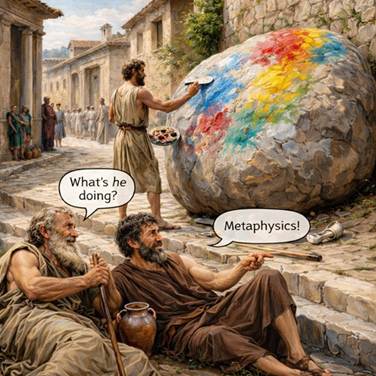
|
Metaphysics: The World’s
Oldest Placebo Retailed by tenured academics
Metaphysics
is what humans do when they hit the wall of “we don’t know” and decide that
silence is unacceptable. So they invent something grand,
vague, unfalsifiable, and pronounce it Ultimate Reality™. Congratulations:
you now have Being, God, Dao, Substance, Emptiness, the Absolute, the Ground
of Grounds, or whatever brand name happens to sell in your cultural
marketplace. Let’s
be precise: metaphysics has discovered exactly nothing beyond nature. Zero.
Zilch. Nada. After physics comes… more talking. That’s it. “Meta” doesn’t
mean deeper reality; it means deeper word salad. The universe keeps doing
what it does—stars explode, bodies decay, organisms scramble to survive—while
metaphysicians argue about whether the ultimate substrate is Being,
Non-Being, or Being-That-Is-Non-Being-On-Tuesdays. Metaphysics
is a placebo for existential anxiety. People don’t like randomness, finitude,
and death, so they inject, indeed intoxicate themselves with a story about an
ultimate order, ground, or truth. It doesn’t cure anything, but it makes the
patient feel seen. Like sugar pills for the soul—except these ones come with
robes, temples, universities, and tenure (with generous income). And
what a marvellous business model it is. First, invent a problem no one can
test: “What is the ultimate nature of reality?” Then sell interpretations of
the answer. Better still, make the answer permanently vague so it can never
be wrong. God works in mysterious ways. Dao cannot be named. Emptiness is not
a thing. Substance has infinite attributes. Translation: the placeholder is
immune to failure. You can pour any disappointment into it and call it
wisdom. Of
course, metaphysics loves to pretend it’s courageous truth-seeking. In reality, it’s sophisticated avoidance. Instead of
looking at the banal facts—organisms suffer, things decay, everything is
conditional—we build abstract cathedrals in language and admire our own
cleverness. Greek metaphysics did it with Substance and Forms. Indian metaphysics
did it with Brahman and Emptiness. Different costumes, same circus. The
real genius of metaphysics isn’t explanatory power; it’s social power.
Metaphysical placeholders create priesthoods, experts, gatekeepers of
“ultimate insight.” Ordinary people see impermanence and conditionality every
day. Metaphysicians see “ontological structures” and charge admission. The
Buddha said: observe transience, stop reifying, suffering eases. The
metaphysician says: yes, but first, let me explain the ultimate nature of
non-ultimacy in seven volumes. And
the final joke? Metaphysics loves to call itself “beyond nature,” while being
one of nature’s most predictable products: anxious primates inventing cosmic
backstories to cope with the fact that the universe doesn’t care. Metaphysics
is not a revelation about reality. It’s a behavioural tic of frightened
animals who learned to talk. So here’s the cynical bottom
line: metaphysics is not wrong. It’s worse. It’s empty, socially useful
theatre. A comforting fiction that becomes dangerous the moment people forget
it’s a prop. Nature goes on doing its blind, conditional thing. Metaphysics
goes on doing its blind, institutional thing. One generates worlds. The other
generates departments. Metaphysics as
vacuous placeholder Two
Truths or Two Distractions? The druid said:
“Metaphysics is a spoof!” |